The 12 Houses (十二宮位)
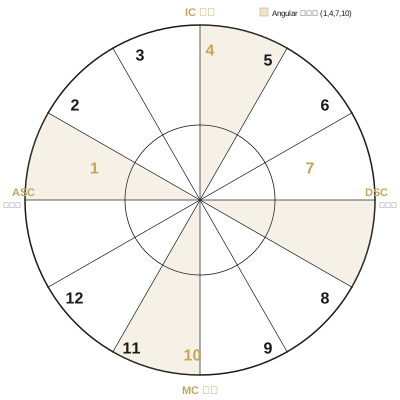
The twelve houses divide the local sky as seen from the birthplace into twelve sectors, each governing a specific sphere of lived experience. Unlike the signs (which are fixed divisions of the ecliptic), the houses rotate with the Earth's daily rotation, anchored by the Ascendant (Rising Sign) — the degree of the ecliptic rising over the eastern horizon at the birth moment. Houses are the most time- and location-sensitive part of the chart.
The Four Angles (四軸)
Four pivotal points anchor the house framework:
- Ascendant (ASC, 上升點): Cusp of 1st House — the self, appearance, dawn.
- Descendant (DSC, 下降點): Cusp of 7th House — others, partnerships, sunset.
- Midheaven (MC, 天頂): Cusp of 10th House — career, public life, noon.
- Imum Coeli (IC, 天底): Cusp of 4th House — home, roots, midnight.
The Twelve Houses
| House | Traditional Name | Domain | Natural Sign |
|---|---|---|---|
| 1st | The Helm (舵手宮) | Self, body, appearance, first impressions | Aries |
| 2nd | The Gate of Hades (財帛宮) | Money, possessions, values, self-worth | Taurus |
| 3rd | The Goddess (兄弟宮) | Communication, siblings, short travel, early education | Gemini |
| 4th | The Underground (田宅宮) | Home, family, roots, the past, the father/mother | Cancer |
| 5th | Good Fortune (子女宮) | Creativity, children, romance, pleasure, play | Leo |
| 6th | Bad Fortune (疾厄宮) | Health, daily work, service, habits, pets | Virgo |
| 7th | The Setting Place (夫妻宮) | Partnerships, marriage, open enemies | Libra |
| 8th | Idle Place (死亡宮) | Death, transformation, shared resources, sexuality, inheritance | Scorpio |
| 9th | God (遷移宮) | Higher education, philosophy, religion, long travel, law | Sagittarius |
| 10th | The Pinnacle (官祿宮) | Career, reputation, authority, public life | Capricorn |
| 11th | Good Daemon (福德宮) | Friends, community, hopes, aspirations, groups | Aquarius |
| 12th | Bad Daemon (玄祕宮) | Hidden matters, retreat, isolation, karma, the unconscious | Pisces |
House Groupings
Houses cluster into meaningful groups:
- Angular Houses (1, 4, 7, 10): The most powerful. Planets here manifest strongly and visibly.
- Succedent Houses (2, 5, 8, 11): Follow the angles; consolidate and sustain the angular themes.
- Cadent Houses (3, 6, 9, 12): Precede the angles; dispersive, mental, preparatory energy.
This tripartite division mirrors the Chinese concept of angular (旺), declining (相), and dormant (囚/死) qi states in BaZi and Flying Stars assessments.
Vedic Parallel
Vedic Jyotish uses the identical 12-house framework (Bhavas, பாவம்), though the house systems and calculation methods differ. The Whole Sign house system, popular in modern Hellenistic revival, is actually the standard method in Jyotish — a historical convergence point of the two traditions.