House Systems Compared (宮位制比較)
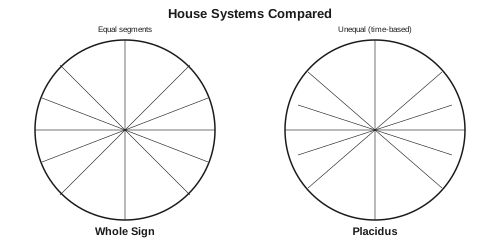
One of the most actively debated technical questions in Western astrology is the choice of house system — the mathematical method used to divide the chart into twelve houses. While the Ascendant (1st house cusp) and Midheaven (10th house cusp) remain constant across most systems, the intermediate house cusps (2nd through 6th, 8th through 11th) are calculated differently by each method, sometimes placing planets in entirely different houses.
Why House Systems Differ
The challenge is that a 'house' must bridge two different coordinate systems: the ecliptic (zodiacal longitude) and the local horizon/meridian (the observer's sky). Different systems resolve this projection problem differently, with each approach having philosophical and geometric justifications.
Major House Systems
- Whole Sign Houses (整體星座宮位制): The oldest and simplest system. The Rising Sign becomes the entire 1st house (all 30°); the next sign is the 2nd house, etc. The Midheaven floats freely and is not automatically the 10th house cusp. Used in Hellenistic astrology and standard in Vedic Jyotish. Pros: clean, conceptually elegant. Cons: ignores the MC-IC axis as house cusps.
- Placidus (普拉西達斯): The most widely used system in modern Western astrology. Divides the semi-arc (the path a degree travels from horizon to meridian) into three equal time segments. Works well in temperate latitudes but breaks down above ~60° north/south (cannot be calculated for circumpolar degrees). The system was default in most 20th-century software.
- Koch (科赫): Similar to Placidus but uses birthplace latitude more directly. Popular in German-speaking astrology circles. Also struggles at extreme latitudes.
- Equal House (等宮制): The Ascendant degree is the 1st house cusp; each subsequent house cusp is exactly 30° later. Simple and works at all latitudes, but the MC is not the 10th house cusp.
- Campanus (坎帕納斯): Divides the prime vertical (the circle passing through the East/West points and the zenith/nadir) into 12 equal parts. Philosophically linked to the directions of the local space.
- Regiomontanus (雷吉奧蒙塔努斯): Divides the celestial equator into 12 equal parts projected onto the ecliptic. Preferred by many horary astrologers for its mathematical elegance.
- Porphyry (波菲利): Trisects the arc between each angle. Simple and philosophically straightforward; popular with those returning to classical methods.
Practical Guidance
For beginners: start with Placidus (most available resources use it) or Whole Sign (conceptually clearest, and matches Vedic structure). For study of classical/Hellenistic texts: use Whole Sign. For horary work: Regiomontanus is traditional. Always note which system you are using when discussing chart placements, as a planet on a 1st/2nd house cusp boundary may change houses across systems.
The Latitude Problem
Above approximately 60° latitude (Scandinavia, Alaska, Siberia), quadrant systems like Placidus and Koch produce extremely distorted houses — some houses may span more than 60° while others occupy less than 10°. Whole Sign and Equal House remain stable at all latitudes, making them preferable for charts cast at extreme locations.