Western Astrology — Overview (西方占星概覽)
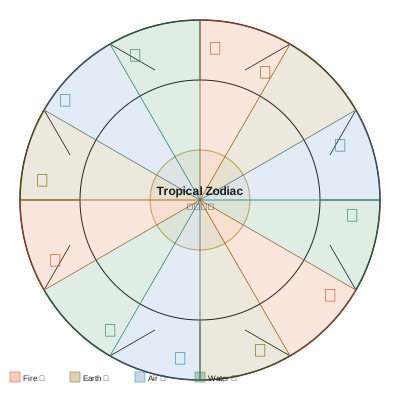
Western astrology is one of humanity's oldest symbolic languages, tracing its roots to ancient Mesopotamia and refined across millennia by Babylonian, Hellenistic, Arabic, and Renaissance scholars. At its core, it is a system that maps the positions of celestial bodies at the moment of birth (or any significant event) onto a circular chart called the horoscope (ὡροσκόπος, 'hour watcher'), interpreting those positions as meaningful signatures of character, potential, and timing.
Historical Arc
The tradition passes through five great periods:
- Babylonian (c. 2000–400 BCE): Omen-based sky observation, development of the zodiac, planetary cycles.
- Hellenistic (c. 400 BCE–400 CE): Marriage of Babylonian technique with Greek philosophy; Claudius Ptolemy's Tetrabiblos codifies the system. Concepts of houses, aspects, dignities, and lots emerge. Vettius Valens' Anthology preserves practical technique.
- Arabic/Medieval (c. 700–1400 CE): Transmission and expansion through Islamic scholars (Abu Ma'shar, Al-Biruni); refined prediction techniques, Arabic Parts (Lots), and horary astrology flourish.
- Renaissance to Early Modern (1400–1900): William Lilly's Christian Astrology (1647) marks the high point of English horary. Astrology gradually separates from astronomy. The discovery of Uranus (1781), Neptune (1846), and Pluto (1930) expands the symbolic vocabulary.
- 20th-Century Psychological Turn & 21st-Century Revival: Dane Rudhyar (1936) reframes astrology through Jungian archetypes, birthing humanistic and psychological schools. Liz Greene deepens the psychological approach. Simultaneously, Project Hindsight (1993) and scholars like Chris Brennan and Demetra George spearhead a Hellenistic revival — recovering ancient techniques (sect, profections, zodiacal releasing) that had been dormant for centuries. Today's practitioner can draw from both streams.
The Core Framework
Every Western horoscope is built from four interlocking layers:
- Planets & Luminaries (行星與發光體): The Sun, Moon, and eight planets each represent a fundamental psychological drive or life principle.
- Zodiac Signs (星座): Twelve 30° divisions of the ecliptic, each colouring planetary expression with a distinct quality.
- Houses (宮位): Twelve sectors of the local sky, each governing a sphere of lived experience.
- Aspects (相位): Angular relationships between planets that describe how drives interact — harmoniously or tensionally.
Cross-Cultural Parallels
Western astrology shares deep structural parallels with both Vedic (Jyotish) and Chinese systems. Like Jyotish, it uses a zodiac, houses, and planetary dignities; like Chinese BaZi (八字), it analyses a birth moment through multiple overlapping frameworks to reveal character and timing. However, Western astrology uses the tropical zodiac (anchored to the seasons, not the fixed stars), distinguishing it from Jyotish's sidereal zodiac. The philosophical emphasis also differs: Western practice often focuses on psychological self-understanding, while classical Chinese arts tend toward fate and timing assessment.
What a Chart Reveals
A natal chart is not a predetermined fate but a symbolic map of potential. It describes personality (Sun, Moon, Rising), relational patterns (Venus, Mars, 7th house), career drives (Saturn, 10th house), and unconscious patterns (Pluto, Neptune, 12th house). Timing techniques — transits, progressions, solar returns — show when dormant potentials are activated by current planetary movements.
How to Use This Course (課程使用指南)
This course is organized into four progressive tiers:
- Tier 1 — Foundations (基礎): Signs, planets, houses, aspects, the Big Three, angles, elements/modalities, and a step-by-step natal reading method. Start here.
- Tier 2 — Practitioner (修行者): Psychological astrology, dignities, dispositors, sect, chart synthesis, synastry, vocational work, and lunar phases. Build interpretive depth.
- Tier 3 — Professional (專業): Hellenistic time-lord techniques, electional/horary, mundane/medical astrology, rectification, fixed stars, and professional ethics. For serious practice.
- Tier 4 — Mastery & Research (精通與研究): Comparative frameworks, astrolocality, declination, midpoints, draconic charts, epistemology, and innovation. For advanced practitioners and researchers.
Each tier builds on the previous one. Cross-cultural parallels with Vedic and Chinese systems are woven throughout.
'The stars incline, they do not compel.' — Medieval astrological maxim