The Major Aspects (主要相位)
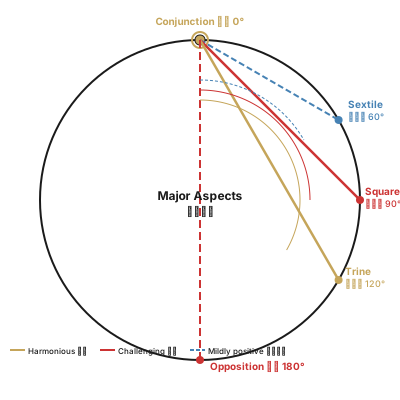
Aspects are the angular relationships between planets as measured around the 360° horoscope wheel. When two planets are separated by a significant angle (with a small allowable margin called an orb), they form an aspect — a dynamic relationship that modifies how each planet expresses itself. Aspects are among the most nuanced interpretive tools in Western astrology.
The Five Ptolemaic Aspects
Claudius Ptolemy defined five major aspects based on the number theory of Pythagorean mathematics — each angle derives from dividing the circle by a simple integer:
| Aspect | Chinese | Angle | Divisor | Quality | Symbol |
|---|---|---|---|---|---|
| Conjunction | 合相 | 0° | 1 | Intensifying (neutral) | ☌ |
| Sextile | 六分相 | 60° | 6 | Harmonious (easy flow) | ⚹ |
| Square | 四分相 | 90° | 4 | Challenging (tension) | □ |
| Trine | 三分相 | 120° | 3 | Harmonious (natural gift) | △ |
| Opposition | 對分相 | 180° | 2 | Challenging (polarisation) | ☍ |
Understanding Each Aspect
- Conjunction (0°, 合相): Two planets occupy the same degree. Their energies merge, amplify, and blend. Neither planet can express independently — they become a compound force. Quality depends entirely on the planets involved.
- Sextile (60°, 六分相): Two planets in signs of compatible element (Fire-Air or Earth-Water). An opportunity aspect — the flow is available but requires some initiative to activate.
- Square (90°, 四分相): Two planets in signs of the same modality (Cardinal-Cardinal, Fixed-Fixed, Mutable-Mutable) but incompatible elements. Creates friction, drive, and challenge. Often the aspect of greatest achievement through struggle.
- Trine (120°, 三分相): Two planets in signs of the same element. Natural talent, ease, and flow. The risk is complacency — gifts so natural they may be taken for granted.
- Opposition (180°, 對分相): Planets in opposite signs. Creates a push-pull between two life areas. Often plays out through projection onto others or through significant relationships.
Orbs (容許度)
An orb is the allowable deviation from the exact angle. A 5° orb for the square means planets anywhere from 85°–95° apart are considered in square. Orb conventions vary by tradition:
- Traditional: Larger orbs (up to 10–12°) for Sun and Moon; smaller (6–8°) for other planets.
- Modern: Often tighter orbs (3–5°) for all aspects.
- Applying vs. Separating: An applying aspect (planets moving toward exactness) is considered stronger than a separating aspect (planets moving apart).
Aspect Interpretation Principle
No aspect is purely good or bad. A trine between Saturn and Neptune may mean gifts of structured spirituality; a square between Venus and Jupiter may indicate over-indulgence. Context — the signs, houses, and other chart factors — always determines final meaning. This mirrors the BaZi principle that the same element or stem can be beneficial or harmful depending on the overall chart balance.