Draconic Charts & Nodal Astrology (龍首盤與月交點占星)
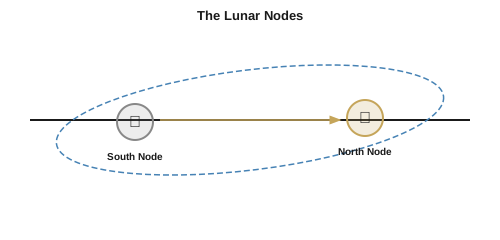
The Lunar Nodes — the two points where the Moon's orbital plane intersects the ecliptic — are among the most philosophically significant points in any astrological system. They are not physical bodies but mathematical points, invisible yet powerful, marking the gateway between the solar and lunar realms. In Western astrology, the nodes have become the primary carriers of karmic and developmental meaning; in Vedic astrology, they are treated as shadow planets of extraordinary power.
The Lunar Nodes Explained
- North Node (☊, Ascending Node, 北交點): Where the Moon's path crosses the ecliptic moving northward. Represents the direction of growth, unfamiliar territory, the qualities the soul seeks to develop in this lifetime.
- South Node (☋, Descending Node, 南交點): Where the Moon's path crosses the ecliptic moving southward. Represents ingrained patterns, past-life skills, comfort zone, and tendencies that no longer serve growth.
The nodal axis always occupies two opposing signs and houses, creating a developmental polarity — a tension between where one has been (South Node) and where one is going (North Node).
The Draconic Chart
The draconic chart (from the Latin draco, dragon — because the nodes were traditionally associated with the dragon's head and tail) is created by rotating the entire natal chart so that the North Node sits at 0° Aries. Every planet shifts by the same amount — the angular relationships (aspects) remain identical, but the signs change.
The interpretation: the draconic chart represents the soul chart — the deeper intention, purpose, or karmic blueprint beneath the surface personality shown by the tropical chart. Where the tropical chart shows who you are, the draconic chart shows who you are meant to become.
Draconic Synastry
One of the most revealing applications of the draconic chart is in synastry. Comparing one person's draconic chart with another's tropical chart reveals soul-level connections — relationships that transcend personality compatibility and touch on deeper karmic purpose. Strong draconic synastry contacts (conjunctions between one person's draconic planets and another's tropical planets) often correlate with relationships that feel profoundly fated or transformative.
Nodal Return (~18.6 Years)
The nodes complete a full cycle through the zodiac in approximately 18.6 years (moving retrograde). The nodal return — when transiting North Node returns to the natal North Node — occurs at approximately:
| Age | Event | Theme |
|---|---|---|
| ~18–19 | First Nodal Return | Initial encounter with life purpose; leaving childhood |
| ~37–38 | Second Nodal Return | Mature reassessment of direction; midlife recalibration |
| ~56–57 | Third Nodal Return | Wisdom integration; legacy orientation |
| ~75–76 | Fourth Nodal Return | Final integration; spiritual completion |
The reverse nodal return (~age 9, 28, 46, 65) — when transiting North Node reaches the natal South Node — brings confrontation with past patterns and a crisis of direction.
Nodal Houses
The natal house containing the North Node indicates the primary growth area — the life domain where one must push beyond comfort. North Node in the 10th house: growth through career, public responsibility, and authority. North Node in the 4th house: growth through family, emotional roots, and inner security.
Eclipses and the Nodes
All eclipses occur near the nodes (within 18° for solar eclipses, 12° for lunar eclipses). This is why eclipses carry such powerful transformative energy — they activate the karmic developmental axis. When an eclipse falls on or near the natal nodes, a major life direction shift is indicated.
Vedic Parallel — Rahu and Ketu
In Vedic astrology (Jyotish), the nodes are treated with far greater prominence than in Western practice. Rahu (राहु, 羅喉) corresponds to the North Node and represents insatiable desire, worldly ambition, obsession, and innovation. Ketu (केतु, 計都) corresponds to the South Node and represents liberation, detachment, spiritual insight, and past-life mastery. Both have full Dasha periods (Rahu: 18 years, Ketu: 7 years in Vimshottari) and are considered among the most powerful forces in the chart. The Vedic treatment of nodes as Chaya Grahas (shadow planets) with real dasha periods gives them an operational weight that Western astrology is only beginning to recover.
Chinese Parallel — Da Liu Ren (大六壬)
In the Chinese tradition, the Da Liu Ren (大六壬) system includes references to the celestial nodes among its Twelve Heavenly Generals and in the concepts of Tian Yi (天乙) and related cosmic pivot points. The structural idea of a cosmic axis that mediates between solar and lunar forces resonates across all three traditions.
'The North Node is the soul's compass. It does not promise comfort — it promises growth.' — Steven Forrest