Aspect Patterns (相位格局)
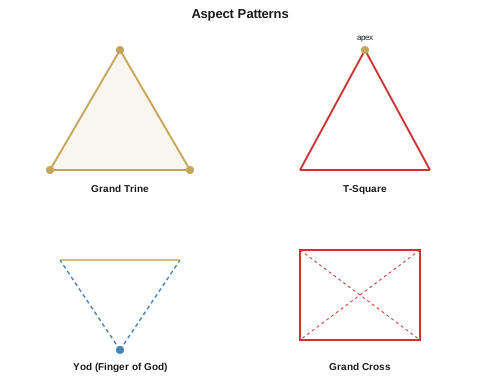
When three or more planets form interlocking aspects, they create recognisable geometric configurations called aspect patterns. These patterns function as unified complexes — the planets involved cannot be interpreted independently; they form a group dynamic that operates as a single thematic structure in the life. Aspect patterns are among the most powerful indicators in chart interpretation.
Major Aspect Patterns
Grand Trine (大三角)
Three planets forming three mutual trines (120°), creating an equilateral triangle in the chart. All three planets share the same element. The Grand Trine is a circuit of ease, talent, and natural flow — but can indicate complacency, self-containment, or difficulty engaging with challenge. A Grand Trine in Fire (牡羊、獅子、射手) describes charismatic, creatively self-sufficient energy; in Earth, practical resourcefulness that may resist outside input.
T-Square (T型三角)
Two planets in opposition (180°) with a third planet squaring both — forming a T-shape. The planet at the apex of the T-Square (the one making two squares) is under the most pressure and represents the dynamic release point of the configuration. T-Squares are among the most productive aspect patterns — high tension drives achievement, but the apex planet's themes are the perpetual stress point. The empty leg opposite the apex is a useful area for resolution.
Grand Cross / Grand Square (大十字)
Four planets forming two oppositions and four squares — a cross within the wheel. All four planets share the same modality. This is one of the most intensely challenging configurations: energy pulls in four directions simultaneously. However, natives with Grand Crosses often accomplish remarkable things precisely because the constant tension forces continuous engagement and development.
Yod / Finger of God (上帝之指)
Two planets in sextile (60°) with a third planet quincunx (150°) to both. The apex planet — the one receiving both quincunxes — is the 'Finger of God,' pointing to a fated, recurring life theme requiring endless adjustment. The sextile base provides creative resource for the difficult apex. Yods are associated with unusual life paths, karmic missions, or persistent challenges that feel externally imposed.
Stellium (群星聚集)
Three or more planets in the same sign or house (often both). The sign/house of the stellium becomes a dominant theme saturating the personality. Multiple planets conjunct blend their energies into a complex compound — both rich and potentially unbalanced, as other life areas may be under-resourced.
Kite (風箏)
A Grand Trine with a fourth planet opposing one of the trine planets and sextiling the other two. The opposition planet provides a point of external challenge that 'flies' the otherwise self-contained Grand Trine. This is considered one of the most fortunate configurations — talent (Grand Trine) with external motivation (opposition) and multiple paths of support (sextiles).
Mystic Rectangle
Two oppositions connected by sextiles and trines — a rectangle with harmonious diagonals. The tension of the oppositions is eased by the surrounding flowing aspects, creating productive polarisation with available resources for resolution.
Applying Pattern Analysis
When identifying patterns: (1) note which planets are involved, (2) assess their dignities and house positions, (3) consider the element/modality of the pattern, (4) identify the 'release point' (apex of T-Square, apex of Yod, opposition planet of Kite). The pattern's element often shows the domain (Fire: identity/creativity, Earth: material/body, Air: mind/relationship, Water: emotion/transformation).