Dispositors, Sect & Planetary Condition (飛星互納、晝夜區分與行星狀態)
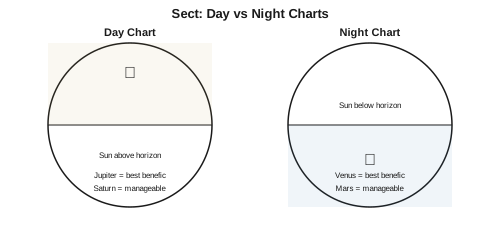
Beyond simple sign and house placement, traditional astrology assesses planetary condition through a sophisticated layered system. A planet's effectiveness depends not just on where it is, but on who manages that territory, whether the planet is operating in its preferred diurnal or nocturnal context, and multiple additional factors that together build a comprehensive picture of planetary strength or debility.
Dispositor Chains (星主鏈)
Every planet in a sign is disposed of by the ruler of that sign. Mars in Taurus is disposed of by Venus (Taurus's ruler). Where is Venus? If Venus is in Capricorn, Venus is disposed of by Saturn. Where is Saturn? This chain continues until it reaches a planet in its own sign (which disposes of itself) or forms a loop.
- Final Dispositor (最終星主): If the chain leads to a single planet in its own domicile — for example, all roads eventually lead to Jupiter in Sagittarius — that planet is the final dispositor of the entire chart. It holds ultimate managerial authority; its condition colours everything.
- Mutual Reception (互容): When two planets are each in the other's sign — Venus in Aries and Mars in Libra — they form a mutual reception, a cooperative exchange that strengthens both. Some traditions treat mutual reception as equivalent to a conjunction.
Sect (晝夜區分)
One of the most powerful and underused traditional techniques. Sect divides charts into two teams:
| Factor | Day Chart (日盤) | Night Chart (夜盤) |
|---|---|---|
| Sect Light | Sun ☉ | Moon ☽ |
| Strongest Benefic | Jupiter ♃ | Venus ♀ |
| Manageable Malefic | Saturn ♄ | Mars ♂ |
| Difficult Malefic | Mars ♂ | Saturn ♄ |
| Mercury | Neutral — joins the sect of whatever planet it is closest to | |
A planet operating in sect performs more constructively; a planet out of sect tends toward its more challenging expressions. This single distinction often explains why two people with similar placements experience them so differently.
Hayz — The Optimal Condition
A planet in hayz (حيز) is in its most favourable condition, meeting three criteria simultaneously:
- In a chart matching its sect (diurnal planet in a day chart, nocturnal planet in a night chart)
- In a sign matching its gender (masculine planet in a masculine sign, feminine planet in a feminine sign)
- In the correct hemisphere (diurnal planet above the horizon by day, nocturnal planet below the horizon by night)
A planet in hayz operates with maximum comfort and effectiveness.
Phasis (相位可見性)
Phasis refers to a planet's visibility relative to the Sun. A planet making its heliacal rising (first appearance from under the Sun's beams) or heliacal setting (last visibility before disappearing under the Sun) is at a moment of peak activation — like a person stepping onto or off a stage.
Planetary Joy (行星歡喜宮)
Each planet has a house where it rejoices — where its nature is most comfortably expressed:
| Planet | Joy House | Rationale |
|---|---|---|
| Mercury ☿ | 1st | The messenger at the threshold |
| Moon ☽ | 3rd | Short journeys, rhythmic cycles |
| Venus ♀ | 5th | Pleasure, creativity, children |
| Mars ♂ | 6th | Labour, conflict, effort |
| Sun ☉ | 9th | Illumination, higher truth |
| Jupiter ♃ | 11th | Good fortune, beneficent alliances |
| Saturn ♄ | 12th | Solitude, confinement, hidden work |
Synthesising Planetary Condition
The complete assessment of a planet's condition combines: essential dignity (domicile, exaltation, triplicity, term, face) + sect (in or out) + house (angular, succedent, cadent) + aspects (bonified by benefics or maltreated by malefics) + phasis (visible or combust) + speed (direct and fast = strong; retrograde and slow = weakened). A planet strong in all these dimensions manifests its significations powerfully and constructively; a planet weak across the board struggles to deliver its promises.
Parallel with BaZi Day Master Assessment
This layered condition assessment closely mirrors the BaZi concept of Day Master strength (日主旺衰). In BaZi, the Day Master's strength depends on seasonal support (月令), surrounding elements (透干通根), and structural relationships (十神配置). Both traditions recognise that a planet/element's condition depends on its full environmental context, not just its intrinsic nature.