Planetary Dignities (行星尊貴)
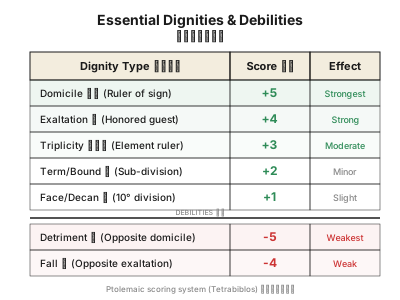
In classical astrology, a planet is not simply 'in' a sign — it has a dignity status that reflects the quality of that placement. A planet in a sign that resonates with its nature operates powerfully and clearly; a planet in a sign hostile to its nature is debilitated, struggling to express cleanly. The dignity system is one of the most important tools for assessing planetary strength in Hellenistic and traditional Western practice.
The Five Essential Dignities (五種尊貴)
- Domicile / Rulership (居所, +5): A planet in the sign it rules. The planet is 'at home,' expressing its nature most freely and powerfully. E.g., Mars in Aries, Venus in Taurus. Parallel to the Chinese concept of 旺 (wang — peak vitality).
- Exaltation (擢升, +4): A sign where a planet functions exceptionally well, even though it is not the ruler. The exaltation placement represents a kind of 'honoured guest' status. E.g., Sun exalted in Aries (0° Aries), Moon exalted in Taurus, Jupiter exalted in Cancer. These were established empirically by Babylonian observation.
- Triplicity (三方, +3): Each element (triplicity) has assigned planetary rulers — day ruler, night ruler, and participating ruler. A planet in its triplicity has moderate dignity appropriate to its sect (daytime vs. nighttime chart).
- Term / Bound (小限, +2): Each sign is divided into five unequal segments called Terms or Bounds, each assigned to a planet. A planet within its own bounds has minor dignity.
- Face / Decan (面相, +1): Each sign is divided into three 10° Decans, each assigned a planet using the Chaldean order. The weakest dignity, but still meaningful.
Debilities (行星受損)
The mirror of dignity is debility:
- Detriment (失利, −5): A planet in the sign opposite its domicile. As uncomfortable as being in an opponent's home. E.g., Mars in Libra, Venus in Aries, Saturn in Cancer.
- Fall (陷落, −4): A planet in the sign opposite its exaltation. Weakened, struggling to find its footing. E.g., Sun in Libra, Moon in Scorpio, Saturn in Aries.
Vedic Parallel (吠陀對照)
The Vedic system uses nearly identical dignities — Svakshetra (own sign, 居所), Ucha (exaltation, 擢升), Neecha (fall, 陷落), and Moolatrikona (root-trine sign). The exaltation degrees are almost identical between traditions, suggesting a shared Babylonian source. In Vedic, Saturn is exalted at 20° Libra; in Western, Saturn is also exalted in Libra — strong convergence.
Mutual Reception (互相接納)
When two planets are each in the other's sign of domicile or exaltation, they are in mutual reception — an exchange that effectively 'rescues' both from potentially challenging placements. E.g., Sun in Aquarius and Saturn in Leo — each is in the other's sign, allowing an interpretive swap that mitigates the detriment condition.
Practical Application
Assessing dignity is essential before interpreting a planet's aspects or house placement. A Jupiter in Cancer (exalted) square Saturn in Aries (fall) reads very differently from a Jupiter in Gemini (peregrine) square Saturn in Libra (exalted). The dignified planet tends to have clearer, more purposeful expression even under difficult aspect conditions.