Cosmology / 宇宙觀
Unlike divination which merely observes destiny, the Fajiao tradition uses these principles to intervene and shape reality according to divine will.
Liuren Magic Sanctuary
The hidden mechanics of the celestial realm.
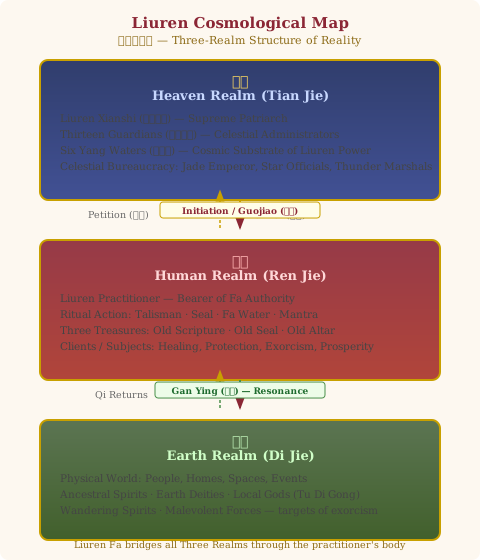
Liuren Three-Realm Cosmological Model (三界宇宙觀)
Unlike divination which merely observes destiny, the Fajiao tradition uses these principles to intervene and shape reality according to divine will.
Fa Power is not self-generated. It is a current of spiritual authority transmitted from the lineage masters to the disciple through the ritual of Guojiao .
The "Spiritual Response." The efficacy of magic depends on the resonance between the practitioner's intention (Yi) and the celestial hierarchy.
Liuren Fajiao (六壬法教), also known as Liuren Shen Gong (六壬神功), is a pragmatic ritual magic tradition within Southern Chinese esoteric Taoism. Its focus is immediate ritual efficacy (灵验) through lineage transmission, ritual procedure, and talismanic practice — not fortune-telling.
As a living folk tradition, it emphasizes survival-grade protection, healing, prosperity, and conflict resolution using 法术 (ritual methods) rather than abstract speculation.
The character 壬 (Ren) is the Yang Water Heavenly Stem — the ninth of the ten Heavenly Stems, governing concealment, penetration, and adaptive flow. The tradition names six specific Yang Stem-Branch combinations as its cosmological anchor: each represents a different modality of Yang Water Qi mapped onto the Five Elements and seasonal cycles.
These six combinations are not merely numerological curiosities. They form the ritual logic behind protection, concealment, and transformation in Liuren practice. Water, in classical Chinese cosmology, is the most yielding substance yet the most penetrative — it flows around all obstacles and ultimately wears them down. This is why Liuren Fa is characterized by adaptive, penetrative magic rather than brute-force confrontation.
| Combination | Pinyin | Five Element Pairing | Seasonal Qi | Ritual Significance |
|---|---|---|---|---|
| 壬子 | Ren Zi | Yang Water over Yang Water (Water²) | Winter Solstice — maximum Yin yielding to new Yang | Deepest concealment power; soul-hiding; maximum receptivity |
| 壬寅 | Ren Yin | Yang Water over Yang Wood | Early Spring — Water nourishing new Wood growth | Protective nurturing; growth-force; guardian-of-the-young applications |
| 壬辰 | Ren Chen | Yang Water over Yang Earth (Dragon) | Late Spring — Earth consolidating spring energy | Grounding and stabilization; Earth-locking protective Qi |
| 壬午 | Ren Wu | Yang Water over Yang Fire — opposing poles | Summer Solstice — maximum Yang; Water-Fire tension | Cooling and fever-reduction (Snow Mountain basis); paradox resolution |
| 壬申 | Ren Shen | Yang Water over Yang Metal | Early Autumn — Metal generates Water; descending cycle | Sharp penetration; cutting through obstacles; exorcistic edge |
| 壬戌 | Ren Xu | Yang Water over Yang Earth (Dog) | Late Autumn — Storage and sealing before winter | Containment; sealing rituals; binding of wandering energies |
Together, these six Yang Water modes cover the complete spectrum of ritual intervention: from the deepest concealment (壬子) to the sharpest penetrating strike (壬申), from nurturing protection (壬寅) to paradoxical cooling-through-fire (壬午). A practitioner who understands the Six Yang Waters understands why Liuren Fa can do what it does — not through brute spiritual force, but through cosmological alignment.
Gan Ying (感應) is the foundational operating principle of all Liuren ritual — and indeed, of classical Chinese physics of sympathy. The concept is deceptively simple: like attracts like; aligned Qi resonates and amplifies; misaligned Qi cancels. But the implications are profound.
In Western physics terms, Gan Ying is analogous to resonance: when two vibrating systems share the same fundamental frequency, energy transfers between them without mechanical connection. In Liuren Fa, this resonance operates between three parties simultaneously:
The practitioner's concentrated mental focus during ritual. Yi is the initial "signal" — the directed electromagnetic-like Qi emanation from the human mind. Without clear Yi, the ritual has no address; it cannot reach its target.
Classical analog: The bow aimed at the target before the arrow is released.
The standardized procedure — talisman, mantra, Hand Seal, Fa Water. The Shi is the carrier wave that amplifies and structures the practitioner's Yi. It creates a repeatable channel that doesn't depend on the practitioner's individual spiritual power.
Classical analog: The arrow itself — the weapon that carries the aim.
The manifestation of divine power in the physical realm — the Guardians responding to the combined Yi + Shi signal. This is the moment of Ling Yan (靈驗) — verified efficacy. The response confirms that the resonance was achieved.
Classical analog: The arrow hitting the mark — but the archer did not force it.
Classical Quote: "感而遂通天下之故"
(Through resonance, one penetrates the affairs of all under Heaven.)
Source: Yijing (易經), Xici Zhuan (繫辭傳) — Commentary on the Attached Words, discussing how the sages "resonated" with Heaven and Earth to produce the hexagrams. Liuren applies this same cosmological principle to ritual action.
The three-part model explains a crucial distinction in Liuren practice: a ritual that "fails" is not a failure of the Dao or of the Guardians — it is a failure of alignment somewhere in the Yi-Shi-Ying chain. Either the practitioner's intention was unclear (scattered Yi), or the ritual form was incorrectly executed (broken Shi), or the request itself was not aligned with natural Dao (no Ying available for that outcome). This framework gives practitioners a diagnostic tool: when a ritual doesn't work, ask where the resonance broke down.
Ba Wu Jin Ji (百无禁忌, literally "A Hundred [Things] Without Taboo") is the most philosophically distinctive doctrine of the Liuren tradition. It is commonly misunderstood as a declaration of moral permissiveness or magical antinomianism — but this reading fundamentally misses the point.
To understand what the doctrine means, it helps to understand what it is contrasted against:
| Tradition | Taboo System | What Liuren Responds To |
|---|---|---|
| Buddhist Karma Doctrine | All intentional action creates karma; practitioners may accumulate "spiritual debt" from working with dark forces or during inauspicious periods. | Liuren asserts that practitioners operating under legitimate lineage authority and genuine compassionate intent are shielded by the Masters from conventional karmic accumulation during ritual work. |
| Confucian Taboo Ethics | Ritual must be performed according to strict social propriety — certain times, persons, or actions are "unclean" and must be avoided. | Liuren refuses to allow social propriety to block urgent ritual work. If someone needs healing at a "bad time" or is in a "ritually unclean" state, the tradition helps anyway. |
| Daoist Wuwei (non-interference) | Some Daoist schools argue that intervention in human affairs is itself a violation of the natural order (Tian Dao). | Liuren counters that the Dao encompasses human compassionate action — intervening to protect the suffering is not a violation of Tian Dao but an expression of it. |
| Folk Magic Taboos | Elaborate calendrical, directional, and personal-condition restrictions (e.g., "Don't perform rituals on your birthday," "Don't face North during exorcism"). | Liuren sweeps away these secondary restrictions as spiritual superstition — the lineage authority supersedes such folk-level prohibitions. |
Ba Wu Jin Ji is a declaration of universal Dao access. It asserts:
"百无禁忌者,非无德,乃以德为禁;非无戒,乃以道为戒。"
(Those who have a Hundred No Taboos are not without virtue — they take virtue itself as their limitation; they are not without precepts — they take the Dao itself as their precept.)
Source: Oral tradition, Fuying Hall (六壬伏英舘)
The ritual of Guojiao (過教, "Crossing the Teaching") is the foundational act of the Liuren tradition. It is not a graduation ceremony, a certificate conferral, or a symbolic gesture — it is understood as the literal transfer of Fa authority from one person to another through a specific ritual technology.
The energetic "signature" of the specific transmission lineage — the Fuying Hall, Fenghuo Academy, or Qunying Hall Qi-print. This is the spiritual "DNA" of the tradition. Without it, talismans drawn from the same Flower Script are inert — form without force.
The recognized authorization from the celestial hierarchy to operate within their system. This is analogous to receiving a "license" — not self-granted, but conferred from above. Without Fa Authority, petitions to the Guardians are not received through the lineage channel.
The catalyst for the disciple's personal spiritual development. Guojiao activates a capacity in the disciple that was previously dormant — the ability to sense, work with, and develop their own Fa sensitivity (法感). This grows through practice over time.
The tradition recognizes two transmission formats, each producing legitimate but different-caliber results:
| Format | Duration | Preparation Required | Quality of Transfer | Historical Context |
|---|---|---|---|---|
| Traditional 49-Day | 49 days of preparation before the Guojiao ceremony | Dietary restrictions, daily practice regimen, study of foundational texts, moral self-examination | Full transfer — maximum depth of lineage Qi, strong Fa Authority link, robust cultivation seed activation | Historical norm; reflects the seven-cycles-of-seven (7×7) completion principle in Chinese numerology |
| Modern 7-Day | 7 days of preparation | Simplified preparation, dietary guidelines, basic study | Valid but lighter transfer — functional Fa Authority established, but requires more sustained practice to fully actualize | Emerged in the diaspora context where practitioners could not maintain 49-day commitments; accepted by traditionalists as emergency measure, criticized by purists as commercial shortcut |
Guojiao is not the end of transmission — it is the beginning. The master-disciple relationship continues through ongoing guidance, the provision of new talismans, and the eventual transmission of higher degrees. The disciple's obligation is threefold: Practice (鍛煉), ensuring the lineage Qi grows and does not stagnate; Study (研習), understanding the principles behind the practice; and Service (服務), using the Fa to help others — which is itself the most powerful method of deepening the lineage connection.
The term "Liuren" (六壬) predates the ritual magic tradition by centuries. Understanding this evolution is essential for placing the Liuren Fajiao we practice today in its proper historical context.
In its original Tang-era form, "Liuren" referred to a sophisticated calendrical and astrological divination system — one of the "Three Cosmic Arts" (三式) alongside Qi Men Dun Jia and Tai Yi. Li Chunfeng and his contemporaries used Liuren divination to determine cosmic timing: when events would occur, where Qi was concentrated, what configurations favored different actions. The core insight was cosmic timing as strategic advantage.
During the Song and Yuan dynasties, Daoist ritual schools absorbed the Liuren calendrical framework into their magical procedures. The "Twelve Monthly Generals" (十二月將) from Liuren divination became ritual invocation targets — not just timing symbols but living spiritual authorities who could be petitioned. This is the crucial transition from observing cosmic order to operating within it.
The "Southern Transmitted Liuren Fa" (南傳六壬法) that forms the basis of the modern Liuren Fajiao emerged in the Hakka and Cantonese cultural zones of southern China. This synthesis combined:
The result is a uniquely practical synthesis: a tradition that carries cosmic-level authority (Heaven-tier legitimization through Li Chunfeng's astronomical standing) while operating at street-level pragmatism (immediate protection, healing, and survival for the common person).
One of the distinctive features of Chinese folk religion — and Liuren Fajiao in particular — is its understanding of the spirit world as a bureaucracy rather than a hierarchy of love or power. This has profound implications for how ritual works.
In the Liuren model, the Thirteen Guardians (十三護法) are not simply "protectors" in a personal sense — they are celestial administrative offices with specific jurisdictions, authorities, and procedures. Just as a government bureaucrat has specific powers within their domain but cannot act outside it, each Guardian operates within their assigned sphere of cosmic authority.
Each of the Thirteen Guardians (玉封十三郎) holds a specific portfolio:
The practitioner's ritual petition must be addressed to the appropriate Guardian for the specific request. Petitioning the wrong Guardian — or issuing a petition without proper lineage authorization — results in no Gan Ying response.
十三護法各持特定職掌:
A properly executed Liuren ritual follows this bureaucratic path:
This model demystifies why ritual works when it works and doesn't when it doesn't. It is not about the practitioner's personal spiritual power — it is about proper procedure within an established celestial administrative system. The most important skills are therefore: knowing which Guardian to petition, how to correctly invoke them, and maintaining sufficient De to keep the channel open.
The Iron Plate tradition is historically noted for its pragmatic, efficacy-first posture. The "Three Noes" are a polemical stance against empty ritualism and rigid textualism.
For a detailed breakdown of Tao, Wuwei, and Internal Alchemy (Neidan) , please study the dedicated guide on Core Taoist Concepts & Internal Alchemy . For the talismanic system that operationalizes these principles, see The Talismanic System .