1. Historical Origins (歷史起源)
📜 Timeline Overview
Tang Dynasty (618-907): Precursor systems emerge (Eighteen Flying Stars 十八飛星, Indian Seven Luminaries 七政四餘)
Song Dynasty (960-1279): Chen Tuan (陳摶) synthesizes ZWDS as unified system
Ming Dynasty (1368-1644): Luo Hongxian standardizes rectangular 12-palace format
Qing Dynasty (1644-1912): Major compilations published (紫微斗數全書, 紫微斗數全集)
Post-1945: Taiwan becomes global preservation and innovation center
Tang Dynasty Precursors (唐代先驅)
| System | Attributed To | Key Features | Influence on ZWDS |
|---|
Eighteen Flying Stars
(十八飛星) | Lu Dongbin (呂洞賓)
Daoist Immortal | 18-star simplified system
Emphasis on Si Hua transformations
Event prediction focus | Foundation for Flying Star school (飛星派)
Si Hua theory framework |
Seven Luminaries & Four Remainders
(七政四餘) | Indian/Persian origin
Tang court astronomers | Sun, Moon, 5 planets + 4 lunar nodes
Actual astronomical positions
Complex calculations | Palace system architecture
Timing techniques (大限/流年) |
Dou Shu (斗數)
Early divination | Folk tradition
Buddhist/Daoist synthesis | Northern Dipper worship
Star god pantheon
Stem-branch calculations | "Dou Shu" name
Zi Wei as Emperor Star
Fixed star positions |
📖 Classical Attribution: Chen Tuan (陳摶 872-989)
Historical Debate: Chen Tuan, a legendary Daoist sage and advisor to Song emperors, is traditionally credited as ZWDS founder. However, scholars debate whether he created the system or systematized existing techniques.
Classical Quote: "紫微斗數,陳希夷所傳" (Zi Wei Dou Shu was transmitted by Chen Xiyi [Chen Tuan's courtesy name])
Likely Reality: Chen Tuan synthesized Tang-era precursors (Eighteen Flying Stars, Dou Shu folk tradition, Indian Seven Luminaries) into a coherent system during the Song Dynasty. His genius was unification and systematization , not invention ex nihilo.
Source: 紫微斗數全書 (Complete Book of Zi Wei Dou Shu), Ming Dynasty compilation
Song Dynasty Systematization (宋代系統化)
During the Song Dynasty (960-1279), Chen Tuan's synthesis gained traction among court astrologers and scholars. Key developments:
- 108-Star Canon: Expansion from 18 Flying Stars to full 108+ star catalog, organized by grade (甲乙丙丁戊)
- Palace System Refinement: 12 palaces standardized with Life Palace (命宮) as anchor, Body Palace (身宮) overlay introduced
- San Fang Si Zheng (三方四正): Triangular palace reading method formalized — "three directions, four upright positions" principle
- Five Elements Bureau (五行局): Birth day divided by Nayin element to determine decade luck cycles (2/3/4/5/6-year bureaus)
- Brightness Levels (廟旺利陷): Star strength matrix developed — each star's power varies across 12 palaces (Miao 廟 = exalted, Xian 陷 = fallen)
By the end of the Song Dynasty, ZWDS had evolved into a complete imperial astrology system , rivaling BaZi Four Pillars in complexity and scope.
Ming Dynasty Standardization (明代標準化)
The Ming Dynasty (1368-1644) saw ZWDS transition from oral transmission to written canon:
| Development | Key Figure | Innovation | Impact |
|---|
| Rectangular Chart Format | Luo Hongxian (羅洪先)
1504-1564 | 4×3 grid replacing circular diagrams
Standardized palace positions | Universal chart format still used today |
| First Printed Manual | 紫微斗數捷覽
(Quick Guide to ZWDS, 1581) | Published calculation formulas
Democratized access beyond court | ZWDS spreads to scholar-officials and merchants |
| School Divergence | Multiple lineages emerge | San He (三合派) vs proto-Flying Star schools
Regional variations in star counts | Foundation for modern school debates |
🔍 Luo Hongxian's Rectangular Format Innovation
Before Luo Hongxian, ZWDS charts were drawn as circular compass diagrams (similar to Feng Shui Luopan), making star placement and triangular readings difficult.
Luo's 4×3 rectangular grid fixed palace positions in a table:
- Row 1 (top): Si 巳, Wu 午, Wei 未, Shen 申
- Row 2 (middle): Chen 辰 [empty] [empty] You 酉
- Row 3 (bottom): Mao 卯, Yin 寅, Chou 丑, Zi 子, Hai 亥, Xu 戌
This format made San Fang Si Zheng triangles geometrically visible and enabled mass printing.
Qing Dynasty Compilations (清代編纂)
The Qing Dynasty (1644-1912) produced the two foundational ZWDS texts still referenced today:
紫微斗數全書 (Complete Book of Zi Wei Dou Shu)
Compiler: Unknown (attributed to "Chen Xiyi School 陳希夷門派")
Date: Early Qing Dynasty (17th century)
Content: 108-star catalog, calculation formulas, palace interpretations, formation patterns (格局 Ge Ju), classical oral mnemonics (口訣)
School: Primarily San He school (三合派) — emphasizes 108+ stars, character analysis, static chart reading
Significance: THE canonical reference for traditional ZWDS. All modern schools derive from this text.
紫微斗數全集 (Complete Collection of Zi Wei Dou Shu)
Compiler: Unknown (possibly multiple editors)
Date: Mid-Qing Dynasty (18th century)
Content: Expanded commentary on 全書, case studies, additional minor stars, alternative calculation methods
School: Eclectic — includes both San He and early Flying Star techniques
Significance: Bridges classical San He and modern Flying Star approaches. Source of many "secret oral transmissions 秘訣"
Post-1945: Taiwan Preservation & Innovation (台灣保存與創新)
After the Chinese Civil War (1949), ZWDS faced suppression in mainland China as "feudal superstition." Taiwan became the global center for preservation and development:
| Period | Development | Key Figures |
|---|
| 1950s-1970s | Classical transmission preservation
Master-disciple lineages formalized
First Taiwanese publications | Lu Zhenchang (陸斌兆)
Wei Qianli (韋千里) |
| 1980s-1990s | Flying Star Revolution (飛星派復興)
18-star simplified system gains popularity
Event prediction emphasis
Computer software development | Wang Tingzhi (王亭之, Cantonese school)
Cai Minghong (蔡明宏) |
| 2000s-Present | Global diaspora teaching
Online calculators proliferate
Academic research in Taiwan universities
Integration with psychology/counseling | Zhong Yiming (鐘義明)
Multiple internet-era teachers |
🌏 Modern Global Landscape
Mainland China: ZWDS resurged post-1980s economic reform. Now widely practiced but often blended with other systems.
Taiwan: Global ZWDS capital. Dozens of schools, extensive publications, university-level courses.
Hong Kong/Macau: Cantonese Flying Star school dominates. Wang Tingzhi's lineage influential.
Singapore/Malaysia: Large Chinese diaspora communities practice both San He and Flying Star.
Western Countries: Growing interest among Chinese diaspora and metaphysics students. English resources limited but expanding.
2. Schools of Practice (派別實踐)
Modern ZWDS has two major schools with distinct philosophies, star systems, and reading methodologies. Understanding both is essential for comprehensive practice.
School Comparison Overview (派別總覽)
| Dimension | San He School (三合派) | Flying Star School (飛星派) |
|---|
| Chinese Name | 三合派 / 南派 (San He Pai / Southern School) | 飛星派 / 北派 / 四化派 (Fei Xing Pai / Northern School / Si Hua Pai) |
| Star Count | 108+ stars (甲乙丙丁戊 five grades) | 18 primary stars (14 major + 4 key auxiliary) |
| Core Methodology | Static chart analysis
Natal personality, character, potential | Dynamic event prediction
Transformations (Si Hua 四化), timing, triggers |
| Reading Focus | "Who you are" — innate nature, talents, life themes | "What will happen" — specific events, timing, outcomes |
| Philosophical Root | Confucian — moral character (德性), social roles, virtue cultivation | Daoist — transformation (變化), flow (流), yin-yang dynamics |
| Complexity Level | High breadth (many stars to memorize)
Moderate depth (impressionistic interpretation) | Moderate breadth (fewer stars)
High depth (multi-layer Flying Star calculations) |
| Learning Curve | Gradual — build up star knowledge slowly
Easier initial readings | Steep — requires mastering Si Hua logic first
Precise but complex |
| Controversy | Si Hua table variations (especially Ren 壬 stem)
Minor star calculation differences | Self-transformation (自化) mechanics
Flying Palace (飛宮) chain limits |
San He School Deep Dive (三合派深入)
三合派 (San He School / Southern School)
Name Origin: "San He 三合" refers to the three-palace triangle reading method (San Fang Si Zheng 三方四正 — "three directions, four upright positions").
Classical Foundation: Based on Qing Dynasty 紫微斗數全書 (Complete Book of Zi Wei Dou Shu). Represents the "orthodox" traditional lineage.
Regional Base: Originally dominant in Southern China (Guangdong, Fujian), Taiwan academic institutions, overseas Chinese communities.
Core Principles:
- 108+ Star System: Uses full A-B-C-D-E grade star catalog. Each star adds nuance to palace interpretation.
- Character Over Events: Focuses on innate nature (天性), life potential (命格), moral character (品德), career suitability (適職性)
- Formation Patterns (格局 Ge Ju): Identifies auspicious/inauspicious star combinations (e.g., "Emperor Meeting Ministers 君臣慶會", "Sandwiched by Killing Stars 夾殺格")
- Brightness Matrix (廟旺利陷): Star strength varies by position — Miao (廟 exalted), Wang (旺 prosperous), Ping (平 neutral), Xian (陷 fallen)
- San Fang Si Zheng Reading: Always read Life Palace + its triangular palaces (Career, Wealth, Travel) + Opposite Palace (Marriage) together
- Decade Luck Emphasis: Da Xian (大限 10-year cycles) analyzed by shifting Life Palace to decade palace and re-reading full triangles
📚 San He School Strengths
✓ Comprehensive Personality Analysis: 108 stars provide rich, multidimensional character portraits
✓ Beginner-Friendly: Can start with 14 major stars, add minor stars gradually
✓ Classical Authority: Direct lineage to Qing texts, extensive historical precedent
✓ Career Counseling: Excellent for vocational guidance, talent identification
✓ Relationship Compatibility: Detailed Marriage Palace analysis with multiple romance stars
⚠️ San He School Limitations
✗ Event Timing Vagueness: Struggles to pinpoint when events occur within decade/year
✗ Impressionistic Readings: Star interpretations can be overly general or contradictory
✗ Memorization Burden: 108+ stars × 12 palaces = 1,296+ interpretation points
✗ School Variations: Different teachers have conflicting star interpretations
Flying Star School Deep Dive (飛星派深入)
飛星派 (Flying Star School / Northern School / Si Hua School)
Name Origin: "Fei Xing 飛星" (Flying Stars) refers to Four Transformations (Si Hua 四化) "flying" from one palace to another during timing analysis (流年/流月/流日).
Classical Foundation: Traces to Tang Dynasty Eighteen Flying Stars (十八飛星) attributed to Lu Dongbin. Revived in 1980s Taiwan/Hong Kong.
Regional Base: Dominant in Hong Kong, Macau, Singapore. Wang Tingzhi (王亭之) Cantonese lineage most influential.
Core Principles:
- 18-Star Minimalism: Only uses 14 major stars + 4 key auxiliaries (Zuo Fu, You Bi, Wen Chang, Wen Qu). Ignores most minor stars as "noise."
- Si Hua Centrality: Everything revolves around Four Transformations (Hua Lu 化祿, Hua Quan 化權, Hua Ke 化科, Hua Ji 化忌) triggered by Heavenly Stems.
- Multi-Layer Timing: Natal Si Hua + Decade Si Hua + Annual Si Hua + Monthly Si Hua + Daily Si Hua = 144 Flying Stars total (12 palaces × 4 transformations × 3 layers)
- Self-Transformation (自化): When a palace's stem triggers its own star to transform (e.g., Life Palace stem causes Life Palace star to Hua Ji)
- Flying Palace (飛宮): Tracing transformation chains across palaces (e.g., "Life Lu flies to Wealth, Wealth Ji flies back to Life" = wealth loss pattern)
- Yin-Yang Palace Classification: 6 Yang palaces (Life, Siblings, Marriage, Children, Wealth, Health) vs 6 Yin palaces (Career, Travel, Friends, Property, Mental, Parents) — different manifestation rules
📚 Flying Star School Strengths
✓ Precise Event Prediction: Can pinpoint specific months/days for career changes, marriage, illness, windfalls
✓ Dynamic Analysis: Captures life's constant transformation, not just static traits
✓ Simpler Star System: 18 stars easier to master than 108
✓ Modern Relevance: Answers "When will X happen?" questions clients actually ask
✓ Logical Rigor: Si Hua rules are systematic, less subjective than impressionistic star readings
⚠️ Flying Star School Limitations
✗ Steep Learning Curve: Si Hua logic is counterintuitive initially (e.g., "Hua Ji in Wealth Palace can be good")
✗ Lacks Personality Depth: 18 stars insufficient for nuanced character analysis
✗ Calculation Complexity: Multi-layer Flying Stars require extensive mental/computational work
✗ School Fragmentation: Many "secret oral transmissions 秘訣" differ between teachers
✗ Over-Determinism Risk: Can become mechanical, losing holistic wisdom
Which School Should You Learn? (該學哪一派?)
🎯 Practical Recommendation: Learn Both Sequentially
Stage 1 — Foundation (San He):
- Master the 14 major stars + 6 auspicious + 6 inauspicious (26 stars total)
- Learn 12 palace meanings, San Fang Si Zheng triangle reading
- Study brightness matrix (廟旺利陷), formation patterns (格局)
- Practice natal chart personality analysis
- Duration: 6-12 months of study
Stage 2 — Dynamics (Flying Star):
- Master Four Transformations (Si Hua) theory — natal/decade/annual layers
- Learn Yin-Yang palace classification, self-transformation (自化) mechanics
- Practice Flying Palace (飛宮) chain reading
- Apply to event prediction — career timing, marriage windows, wealth cycles
- Duration: 12-24 months of intensive practice
Stage 3 — Integration (Synthesis):
- Use San He for "Who are you?" — character, talents, life themes
- Use Flying Star for "What will happen?" — event timing, trigger identification
- Cross-validate: San He formations should align with Flying Star event predictions
- Develop personal style blending both schools' strengths
Classical Support: "三合定性格,飛星斷事應" (San He determines nature, Flying Star divines events)
3. Zi Wei Dou Shu vs BaZi (紫微斗數與八字比較)
Both ZWDS and BaZi are pillars of Chinese metaphysical arts, but they serve different diagnostic purposes. Understanding their relationship prevents confusion and enables complementary usage.
Structural Comparison (結構對比)
| Dimension | Zi Wei Dou Shu (紫微斗數) | BaZi Four Pillars (八字四柱) |
|---|
| Input Data Required | Year, Month, Day, Hour (時辰)
Hour is REQUIRED | Year, Month, Day, Hour (optional)
Hour enhances but not essential |
| Chart Structure | 12-palace grid (命宮/兄弟/夫妻... 12 life domains)
100+ stars placed in palaces | 4 pillars × 2 rows (年月日時 × 天干地支)
8 characters total |
| Primary Elements | Stars (星曜): Zi Wei, Tian Ji, Tai Yang, etc.
Categorized by grade (A/B/C/D/E) | Stems & Branches (干支): 10 Stems + 12 Branches
Five Elements (五行) interactions |
| Analytical Framework | Palace-based: Each palace = life domain
Star combinations in palace reveal outcomes | Element-based: Five Elements balance
Ten Gods (十神) relationships |
| Reading Focus | Life domains separately: Career, Marriage, Wealth, Health analyzed independently then synthesized | Holistic balance: Overall elemental harmony determines all outcomes |
| Precision Level | High specificity: "Marriage Palace has Tan Lang + Wen Qu = artistic spouse, mid-life romance" | General tendencies: "Strong Wealth Star = good earning capacity" |
| Timing System | Decade Luck (大限): 10-year cycles starting age 2-6
Flow Year/Month/Day (流年/流月/流日) | Luck Pillars (大運): 10-year cycles starting age 1-10
Annual Pillars (流年) |
| Calculation Complexity | High: 100+ star positions via formulas
Multi-step lookup tables | Moderate: 8 stem-branch lookups
Ten Gods derivation |
| Learning Curve | Steep initially, gradual expansion:
Learn 14 major stars → add minor stars over time | Steep throughout:
Must master Five Elements interactions before useful readings |
| Best For | Specific life domain analysis
Event timing
Personality profiling
Compatibility assessment | Elemental constitution
Career suitability
Health tendencies
Luck cycle overview |
Complementary Usage Strategy (互補運用策略)
📊 When to Use Zi Wei Dou Shu
✓ Marriage/Relationship Questions: ZWDS Marriage Palace (夫妻宮) provides far more detail than BaZi Spouse Star (配偶星). Can identify spouse appearance, personality, profession, and timing of meeting.
✓ Career Path Specificity: Career Palace (官祿宮) star combinations suggest specific industries (e.g., "Wu Qu + Tian Fu = banking/finance" vs "Tai Yang + Tian Liang = education/government").
✓ Multi-Domain Analysis: Need separate answers for career, wealth, health, relationships? ZWDS palace system excels at compartmentalized analysis.
✓ Event Prediction (Flying Star school): Pinpointing when promotion/marriage/relocation occurs via Si Hua transformations.
✓ Parent-Child Dynamics: Parents Palace (父母宮) and Children Palace (子女宮) provide insights BaZi cannot easily access.
📊 When to Use BaZi
✓ Elemental Constitution: BaZi reveals innate Five Elements balance, useful for health diagnosis (e.g., "Too much Fire, weak Water → heart/kidney issues").
✓ Luck Cycle Overview: BaZi Luck Pillars (大運) show broad 10-year trend (favorable vs unfavorable elements), while ZWDS focuses on specific events within cycles.
✓ Career Element Suitability: BaZi Ten Gods (十神) indicate career type (e.g., "Strong Output → arts/teaching" vs "Strong Wealth → business/sales"), while ZWDS indicates specific industry .
✓ No Birth Hour Available: BaZi works reasonably well with Year-Month-Day only. ZWDS requires birth hour to calculate Life Palace position.
✓ Ancestral/Genetic Tendencies: Year Pillar analysis reveals family karma, generational patterns.
🔗 Integrated Reading Protocol
Step 1 — BaZi Foundation: Run BaZi chart first to establish Five Elements constitution, overall luck trend, career element suitability.
Step 2 — ZWDS Specificity: Run ZWDS chart to identify specific life domain outcomes (marriage quality, wealth sources, career industry).
Step 3 — Cross-Validation: Check for alignment:
- BaZi shows "Strong Wealth Star + Favorable Earth element" → ZWDS Wealth Palace should have auspicious stars (Wu Qu, Tian Fu, Lu Cun)
- BaZi shows "Weak Spouse Star + Clash" → ZWDS Marriage Palace likely has inauspicious stars (Qing Yang, Tuo Luo) or Hua Ji transformation
- BaZi shows "Fire Luck Pillar coming" → Check ZWDS Flow Year (流年) for Fire palaces' Si Hua activations
Step 4 — Synthesis: BaZi provides the "Why" (elemental causes), ZWDS provides the "What/When/Who" (specific manifestations).
Classical Quote: "八字定根基,斗數論細節" (BaZi determines foundation, Dou Shu discusses details)
🔍 Case Study: Marriage Timing Question
Question: "When will I get married, and what will my spouse be like?"
BaZi Analysis:
- Spouse Star (配偶星) is Ding Fire in Month Pillar → spouse likely artistic, refined, gentle
- Spouse Star favorable, no clashes → marriage quality good
- Luck Pillar 30-40 brings favorable Water → marriage likely in this decade
- BaZi Limitation: Cannot narrow down to specific year/month within decade
ZWDS Analysis:
- Marriage Palace (夫妻宮) has Tai Yin + Wen Qu → spouse gentle, educated, possibly in literature/arts (aligns with BaZi Ding Fire)
- Marriage Palace Hua Lu in natal chart → marriage brings happiness
- Flow Year age 33: Marriage Palace receives Hua Lu + Hong Luan (Romance Star) → marriage year likely age 33
- Flow Month analysis: Spring months (寅卯辰) receive additional romance stars → March-May age 33
Integrated Answer: "You will likely marry around age 33, Spring months (March-May). Your spouse will be gentle, artistic, well-educated (possibly in literature/arts field). Marriage quality is favorable."
4. Ten-Step Chart Construction (十步排盤法)
Manual ZWDS chart construction reveals the system's mathematical elegance. While modern calculators automate this process, understanding each step is essential for:
- Troubleshooting software errors: Many online calculators have bugs in minor star placements
- Teaching purposes: Students who construct charts manually develop deeper intuition
- Historical appreciation: Understanding classical oral mnemonics (口訣) and their logic
- Customization: Advanced practitioners use alternative calculation methods for specialized stars
📋 Materials Needed
Required:
- Birth data: Lunar Year, Month, Day, Hour (農曆年月日時)
- Blank 12-palace grid (either circular or rectangular 4×3 format)
- Stem-Branch lookup tables (Perpetual Calendar 萬年曆)
- Star calculation lookup tables (included in classical texts or reference books)
Optional but helpful:
- Color pens (red for major stars, blue for auxiliary, black for inauspicious)
- Calculator for Nayin bureau calculations
- Reference book with 口訣 oral mnemonics
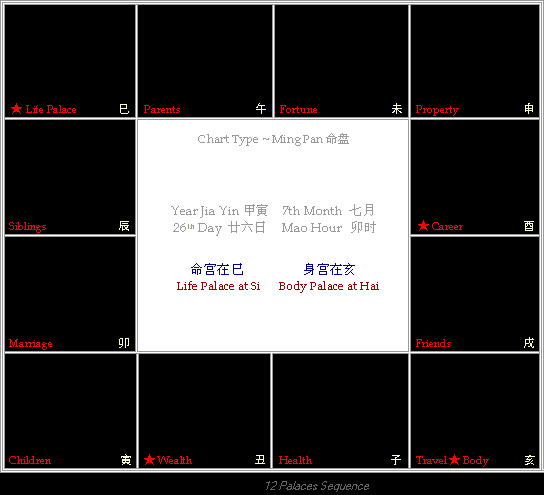
12 Palaces sequence (十二宫顺序)
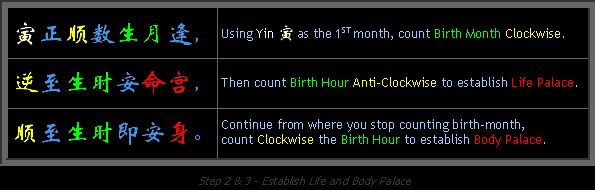
Establish Life and Body Palaces
Step 1: Lunar Calendar Conversion (陰曆轉換)
Purpose: Convert Gregorian (solar) birth date to Chinese lunar date if not already known.
| Conversion Type | Method | Notes |
|---|
| Manual Conversion | Use Perpetual Calendar (萬年曆)
Lookup Gregorian date → Find lunar equivalent | Reliable for dates 1900-2100
Watch for leap months (閏月) |
| Online Tools | Chinese calendar conversion websites
Many ZWDS software tools include this | Verify against multiple sources for dates before 1912 (calendar reforms) |
| Leap Month Issue | If born in leap month (e.g., 閏五月), mark as such — affects Month Branch calculations | Classical rule: Leap month uses previous month's stem-branch |
Example: Gregorian birth date May 15, 1985, 10:30 AM → Lunar date 乙丑年 三月 廿六 巳時 (Year: Yi-Chou, Month: 3rd, Day: 26, Hour: Si)
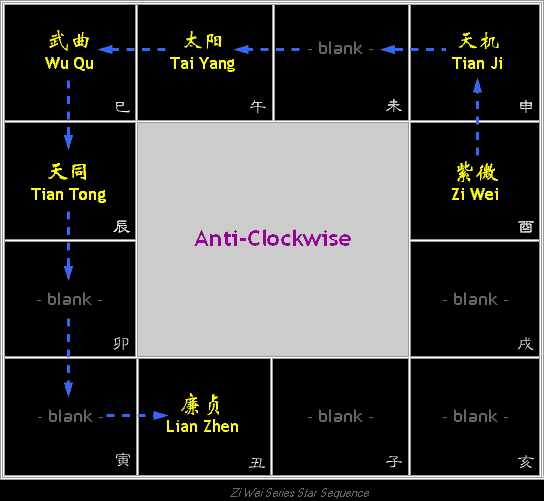
Zi Wei star series placement
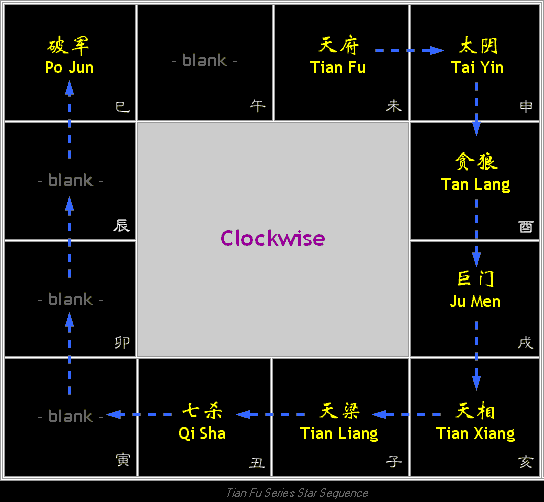
Tian Fu star series placement
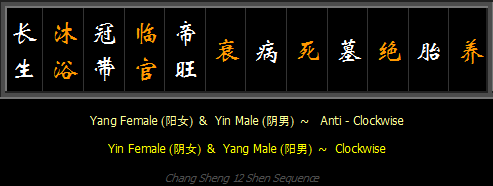
Chang Sheng 12 Stages
Step 2: Life Palace Position (命宮定位)
Purpose: Determine which of the 12 Earthly Branch positions becomes the Life Palace (命宮) — the chart's anchor point.
Formula: Life Palace = (Birth Month + Birth Hour) counted counter-clockwise from Yin 寅
🧮 Life Palace Calculation Method
Classical Mnemonic (口訣): "寅上起正月,順數至生月,再從生月起子時,逆數至生時"
Translation: "Start from Yin for 1st month, count forward to birth month, then from birth month start at Zi hour, count backward to birth hour."
Step-by-Step:
- Assign Yin (寅) palace = 1st lunar month
- Count clockwise to birth month (Mao 卯 = 2nd, Chen 辰 = 3rd, etc.)
- From the birth month palace, assign Zi (子) hour
- Count counter-clockwise to birth hour (Chou 丑 = 23rd hour, Yin 寅 = 1st hour, etc.)
- The final position = Life Palace
Example: Birth Month = 3rd lunar month, Birth Hour = Si (巳時 9-11 AM)
- Step 1-2: Yin 寅 (1st) → Mao 卯 (2nd) → Chen 辰 (3rd month)
- Step 3: Chen palace = Zi hour (子時)
- Step 4 (counter-clockwise): Chen = Zi, Mao = Chou, Yin = Yin, Chou = Mao, Zi = Chen , Hai = Si → Life Palace = Hai 亥
| Birth Month | Birth Hour: Zi 子 | Chou 丑 | Yin 寅 | Mao 卯 | Chen 辰 | Si 巳 | Wu 午 | Wei 未 | Shen 申 | You 酉 | Xu 戌 | Hai 亥 |
|---|
| 1st (寅) | Yin | Chou | Zi | Hai | Xu | You | Shen | Wei | Wu | Si | Chen | Mao |
| 2nd (卯) | Mao | Yin | Chou | Zi | Hai | Xu | You | Shen | Wei | Wu | Si | Chen |
| 3rd (辰) | Chen | Mao | Yin | Chou | Zi | Hai | Xu | You | Shen | Wei | Wu | Si |
| 4th (巳) | Si | Chen | Mao | Yin | Chou | Zi | Hai | Xu | You | Shen | Wei | Wu |
| 5th (午) | Wu | Si | Chen | Mao | Yin | Chou | Zi | Hai | Xu | You | Shen | Wei |
| 6th (未) | Wei | Wu | Si | Chen | Mao | Yin | Chou | Zi | Hai | Xu | You | Shen |
| 7th (申) | Shen | Wei | Wu | Si | Chen | Mao | Yin | Chou | Zi | Hai | Xu | You |
| 8th (酉) | You | Shen | Wei | Wu | Si | Chen | Mao | Yin | Chou | Zi | Hai | Xu |
| 9th (戌) | Xu | You | Shen | Wei | Wu | Si | Chen | Mao | Yin | Chou | Zi | Hai |
| 10th (亥) | Hai | Xu | You | Shen | Wei | Wu | Si | Chen | Mao | Yin | Chou | Zi |
| 11th (子) | Zi | Hai | Xu | You | Shen | Wei | Wu | Si | Chen | Mao | Yin | Chou |
| 12th (丑) | Chou | Zi | Hai | Xu | You | Shen | Wei | Wu | Si | Chen | Mao | Yin |
Step 3: Body Palace Position (身宮定位)
Purpose: Determine the Body Palace (身宮) — a secondary anchor representing post-35 life focus and subconscious drives.
Formula: Body Palace = (Birth Month + Birth Hour) counted clockwise from Chen 辰
Key Difference from Life Palace: Body Palace uses clockwise direction from Chen (辰), while Life Palace uses counter-clockwise from birth month.
| Birth Month + Hour Sum | Body Palace Position | Overlaps With |
|---|
| Sum ≡ 1 (mod 12) | Chen 辰 | Life Palace (coincides only for specific combinations) |
| Sum ≡ 2 (mod 12) | Si 巳 | Parents Palace (典型) |
| Sum ≡ 3 (mod 12) | Wu 午 | Mental Palace |
| Sum ≡ 4 (mod 12) | Wei 未 | Property Palace |
| Sum ≡ 5 (mod 12) | Shen 申 | Career Palace (common) |
| Sum ≡ 6 (mod 12) | You 酉 | Friends Palace |
| Sum ≡ 7 (mod 12) | Xu 戌 | Travel Palace |
| Sum ≡ 8 (mod 12) | Hai 亥 | Health Palace |
| Sum ≡ 9 (mod 12) | Zi 子 | Wealth Palace (common) |
| Sum ≡ 10 (mod 12) | Chou 丑 | Children Palace |
| Sum ≡ 11 (mod 12) | Yin 寅 | Marriage Palace (common) |
| Sum ≡ 0 (mod 12) | Mao 卯 | Siblings Palace |
🔍 Body Palace Significance
Classical Quote: "身主星掌三十歲後運勢" (Body Palace governs fortune after age 30)
Which Palace Body Palace Overlaps:
- Life Palace: Life mission and conscious identity fully aligned — rare, indicates strong self-awareness
- Career Palace: Work becomes life focus post-35 — workaholic tendency or career fulfillment
- Wealth Palace: Money becomes central concern — entrepreneurial drive or materialism
- Marriage Palace: Spouse/partnership central to identity — strong relational focus
- Mental Palace: Spiritual/philosophical pursuits dominate — religious or scholarly inclination
See Palaces Guide for full 12-position Body Palace analysis.
Step 4: Palace Heavenly Stems (宮位天干安星)
Purpose: Assign a Heavenly Stem (天干) to each of the 12 palaces. These stems determine Si Hua transformations (四化) later.
Method: Use Five Tiger Escape (五虎遁) formula based on Year Stem and Month Branch.
🐯 Five Tiger Escape Formula (五虎遁月訣)
Classical Mnemonic:
"甲己之年丙作首,乙庚之歲戊為頭,
丙辛必定尋庚起,丁壬壬位順流行,
若問戊癸何方發,甲寅之上好追求"
Translation:
- Jia (甲) or Ji (己) year → Yin month starts with Bing (丙) stem
- Yi (乙) or Geng (庚) year → Yin month starts with Wu (戊) stem
- Bing (丙) or Xin (辛) year → Yin month starts with Geng (庚) stem
- Ding (丁) or Ren (壬) year → Yin month starts with Ren (壬) stem
- Wu (戊) or Gui (癸) year → Yin month starts with Jia (甲) stem
Then: From Yin month's stem, count forward through 10 Stems for remaining months (Mao, Chen, Si, etc.)
| Year Stem | Yin 寅
(1st Month) | Mao 卯
(2nd) | Chen 辰
(3rd) | Si 巳
(4th) | Wu 午
(5th) | Wei 未
(6th) | Shen 申
(7th) | You 酉
(8th) | Xu 戌
(9th) | Hai 亥
(10th) | Zi 子
(11th) | Chou 丑
(12th) |
|---|
| Jia 甲 / Ji 己 | Bing 丙 | Ding 丁 | Wu 戊 | Ji 己 | Geng 庚 | Xin 辛 | Ren 壬 | Gui 癸 | Jia 甲 | Yi 乙 | Bing 丙 | Ding 丁 |
| Yi 乙 / Geng 庚 | Wu 戊 | Ji 己 | Geng 庚 | Xin 辛 | Ren 壬 | Gui 癸 | Jia 甲 | Yi 乙 | Bing 丙 | Ding 丁 | Wu 戊 | Ji 己 |
| Bing 丙 / Xin 辛 | Geng 庚 | Xin 辛 | Ren 壬 | Gui 癸 | Jia 甲 | Yi 乙 | Bing 丙 | Ding 丁 | Wu 戊 | Ji 己 | Geng 庚 | Xin 辛 |
| Ding 丁 / Ren 壬 | Ren 壬 | Gui 癸 | Jia 甲 | Yi 乙 | Bing 丙 | Ding 丁 | Wu 戊 | Ji 己 | Geng 庚 | Xin 辛 | Ren 壬 | Gui 癸 |
| Wu 戊 / Gui 癸 | Jia 甲 | Yi 乙 | Bing 丙 | Ding 丁 | Wu 戊 | Ji 己 | Geng 庚 | Xin 辛 | Ren 壬 | Gui 癸 | Jia 甲 | Yi 乙 |
Example: Year = Yi-Chou (乙丑), Birth Month = 3rd lunar month (Chen 辰)
- Yi year → Yin month = Wu stem (from table)
- Yin 寅 = Wu 戊, Mao 卯 = Ji 己, Chen 辰 = Geng 庚
- Birth month (3rd Chen) has Geng stem → All palace stems derive from Geng-Chen
Step 5: Five Elements Bureau (五行局數定位)
Purpose: Determine which of the 5 bureaus (水二局/木三局/金四局/土五局/火六局) the chart belongs to. This affects:
- Zi Wei star position (varies by bureau)
- Decade luck starting age (2/3/4/5/6 years old)
- Longevity Stars sequence (長生十二神)
Method: Look up the Life Palace stem-branch combination in the Nayin (納音) table to determine its element.
| Bureau | Nayin Sounds (納音 examples) | Starting Age | Decade Cycles |
|---|
| Water 2 (水二局) | 澗下水, 大溪水, 長流水, 天河水, 井泉水, 大海水 | 2 years | 2-11, 12-21, 22-31, 32-41... |
| Wood 3 (木三局) | 桑柘木, 松柏木, 大林木, 楊柳木, 石榴木, 平地木 | 3 years | 3-12, 13-22, 23-32, 33-42... |
| Metal 4 (金四局) | 金箔金, 劍鋒金, 白蠟金, 沙中金, 海中金, 釵釧金 | 4 years | 4-13, 14-23, 24-33, 34-43... |
| Earth 5 (土五局) | 路旁土, 城頭土, 屋上土, 壁上土, 大驛土, 沙中土 | 5 years | 5-14, 15-24, 25-34, 35-44... |
| Fire 6 (火六局) | 爐中火, 山頭火, 霹靂火, 山下火, 佛燈火, 天上火 | 6 years | 6-15, 16-25, 26-35, 36-45... |
Example: Life Palace = Geng-Chen (庚辰) → Nayin = 白蠟金 (White Wax Metal) → Metal 4 Bureau → Decade luck starts age 4
⚠️ Common Mistake: Using Birth Year Instead of Life Palace
Many beginners incorrectly use the birth year's Nayin to determine the bureau. This is wrong!
The Five Elements Bureau is determined by the Life Palace stem-branch combination , NOT the birth year.
Why: ZWDS is a palace-centric system. The Life Palace anchors all calculations.
Step 6: Zi Wei Star Position (紫微星定位)
Purpose: Place the Zi Wei (紫微) star, the "Emperor Star" and most important star in the chart.
Formula: Zi Wei position = (Five Elements Bureau × Birth Day) modulo 12
🔢 Zi Wei Calculation Formula
Step 1: Identify Five Elements Bureau number (2/3/4/5/6)
Step 2: Multiply bureau number by birth day (lunar)
Step 3: Starting from Yin (寅) palace, count forward by the result (modulo 12)
Example: Bureau = 4 (Metal), Birth Day = 26
- 4 × 26 = 104
- 104 ÷ 12 = 8 remainder 8
- Count 8 positions from Yin: Yin→Mao→Chen→Si→Wu→Wei→Shen→ You (酉)
- Zi Wei placed in You (酉) palace
Classical Mnemonic: "生日局數相乘,寅上起數,順數至天數為紫微"
(Multiply birth day by bureau number, count from Yin, result is Zi Wei position)
Step 7: Remaining 13 Major Stars (十四主星配置)
Purpose: Place the remaining 13 major stars based on Zi Wei's position.
Method: All major stars have fixed relationships to Zi Wei. Once Zi Wei is placed, the other 13 follow automatically.
| Star | Offset from Zi Wei | Direction | Example (if Zi Wei in You 酉) |
|---|
| Zi Wei Series (紫微系 - Counter-Clockwise from Zi Wei) |
| Zi Wei 紫微 | 0 (base position) | — | You 酉 |
| Tian Ji 天機 | 1 position counter-clockwise | ← | Shen 申 |
| Tai Yang 太陽 | 3 positions counter-clockwise | ← | Wu 午 |
| Wu Qu 武曲 | 4 positions counter-clockwise | ← | Si 巳 |
| Tian Tong 天同 | 5 positions counter-clockwise | ← | Chen 辰 |
| Lian Zhen 廉貞 | 8 positions counter-clockwise | ← | Chou 丑 |
| Tian Fu Series (天府系 - Clockwise from Tian Fu) |
| Tian Fu 天府 | Same as Tai Yin (opposite Zi Wei + 4) | Special | Mao 卯 |
| Tai Yin 太陰 | Opposite Zi Wei + 4 clockwise | → | Mao 卯 |
| Tan Lang 貪狼 | 1 position clockwise from Tian Fu | → | Chen 辰 |
| Ju Men 巨門 | 2 positions clockwise from Tian Fu | → | Si 巳 |
| Tian Xiang 天相 | 3 positions clockwise from Tian Fu | → | Wu 午 |
| Tian Liang 天梁 | 4 positions clockwise from Tian Fu | → | Wei 未 |
| Qi Sha 七殺 | 5 positions clockwise from Tian Fu | → | Shen 申 |
| Po Jun 破軍 | Opposite Zi Wei | Direct opposite | Mao 卯 |
🌟 The Celestial Dance: Northern vs Southern Stars
Northern Dipper Stars (北斗 Zi Wei Series): Move counter-clockwise from Zi Wei. Represent Yang energy, action, leadership, external manifestation.
Southern Dipper Stars (南斗 Tian Fu Series): Move clockwise from Tian Fu. Represent Yin energy, storage, support, internal cultivation.
Classical Quote: "北斗主生,南斗主死;北斗司剛,南斗司柔"
(Northern Dipper governs birth/hardness, Southern Dipper governs death/softness — "death" here means completion/storage, not literal death)
Step 8: Auxiliary Stars (輔星安置)
Purpose: Place the Six Lucky Stars (六吉星) and Six Harmful Stars (六煞星) that modify major star influences.
These 12 stars are calculated from:
- Year Stem: Tian Kui (天魁), Tian Yue (天鉞), Lu Cun (祿存)
- Birth Hour: Wen Chang (文昌), Wen Qu (文曲), Di Kong (地空), Di Jie (地劫)
- Year Branch: Zuo Fu (左輔), You Bi (右弼), Qing Yang (擎羊), Tuo Luo (陀羅), Huo Xing (火星), Ling Xing (鈴星)
| Star | Calculation Base | Formula | Category |
|---|
| Zuo Fu 左輔 | Year Branch | Chen year → Chen palace; count forward by year branch | Lucky - Left Assistant |
| You Bi 右弼 | Year Branch | Opposite position of Zuo Fu | Lucky - Right Assistant |
| Tian Kui 天魁 | Year Stem | Jia/Wu→Chou, Yi/Ji→Shen, Bing/Ding→Hai, Geng→Yin, Xin→Wu, Ren/Gui→Mao | Lucky - Yang Nobleman |
| Tian Yue 天鉞 | Year Stem | Jia→Shen, Yi→Si, Bing/Ding→You, Wu→Hai, Ji→Xu, Geng→Chou, Xin→Yin, Ren/Gui→Wei | Lucky - Yin Nobleman |
| Wen Chang 文昌 | Birth Hour | Zi→Si, Chou→Wu, Yin→Shen, Mao→You, pattern continues | Lucky - Literary Excellence |
| Wen Qu 文曲 | Birth Hour | Opposite pattern from Wen Chang | Lucky - Literary Arts |
| Qing Yang 擎羊 | Year Branch | 1 position forward from Lu Cun | Harmful - Blade Star |
| Tuo Luo 陀羅 | Year Branch | 1 position backward from Lu Cun | Harmful - Spinning Top |
| Huo Xing 火星 | Year Branch + Hour | Complex formula based on year-hour combination | Harmful - Fire Star |
| Ling Xing 鈴星 | Year Branch + Hour | Offset pattern from Huo Xing | Harmful - Bell Star |
| Di Kong 地空 | Birth Hour | Hai hour→Hai palace; count by hour branch | Harmful - Void 1 |
| Di Jie 地劫 | Birth Hour | Opposite position of Di Kong | Harmful - Void 2 |
Note: See Stars Reference page for complete calculation formulas and lookup tables.
Step 9: Si Hua Transformations (四化星配置)
Purpose: Apply the Four Transformations (四化) based on the Year Stem . These transform 4 of the existing stars into dynamic energies.
Four Transformation Types:
- Hua Lu 化祿 — Transformation into Wealth/Opportunity (吉)
- Hua Quan 化權 — Transformation into Authority/Power (吉)
- Hua Ke 化科 — Transformation into Fame/Recognition (吉)
- Hua Ji 化忌 — Transformation into Obstruction/Taboo (凶)
| Year Stem | Hua Lu 化祿 | Hua Quan 化權 | Hua Ke 化科 | Hua Ji 化忌 |
|---|
| Jia 甲 | Lian Zhen 廉貞 | Po Jun 破軍 | Wu Qu 武曲 | Tai Yang 太陽 |
| Yi 乙 | Tian Ji 天機 | Tian Liang 天梁 | Zi Wei 紫微 | Tai Yin 太陰 |
| Bing 丙 | Tian Tong 天同 | Tian Ji 天機 | Wen Chang 文昌 | Lian Zhen 廉貞 |
| Ding 丁 | Tai Yin 太陰 | Tian Tong 天同 | Tian Ji 天機 | Ju Men 巨門 |
| Wu 戊 | Tan Lang 貪狼 | Tai Yin 太陰 | You Bi 右弼 | Tian Ji 天機 |
| Ji 己 | Wu Qu 武曲 | Tan Lang 貪狼 | Tian Liang 天梁 | Wen Qu 文曲 |
| Geng 庚 | Tai Yang 太陽 | Wu Qu 武曲 | Tai Yin 太陰 | Tian Tong 天同 |
| Xin 辛 | Ju Men 巨門 | Tai Yang 太陽 | Wen Qu 文曲 | Wen Chang 文昌 |
| Ren 壬 | Tian Liang 天梁 | Zi Wei 紫微 | Zuo Fu 左輔 | Wu Qu 武曲 (or Tian Fu 天府*) |
| Gui 癸 | Po Jun 破軍 | Ju Men 巨門 | Tai Yin 太陰 | Tan Lang 貪狼 |
* Ren stem Hua Ji controversy: San He school uses Wu Qu; some Flying Star schools use Tian Fu. See Si Hua page for full debate.
Example: Birth Year = Yi-Chou (乙丑)
- Year Stem = Yi (乙)
- Wherever Tian Ji sits → mark as 化祿
- Wherever Tian Liang sits → mark as 化權
- Wherever Zi Wei sits → mark as 化科
- Wherever Tai Yin sits → mark as 化忌
Step 10: Minor Stars & Cyclic Sequences (雜曜及神煞配置)
Purpose: Add the remaining 90+ minor stars (C/D/E grade) and four 12-star cyclic sequences.
Categories to place (see detailed formulas in reference documents):
| Category | Key Stars | Calculation Base |
|---|
| Romance/Peach Blossom | Hong Luan 紅鸞, Tian Xi 天喜, Tian Yao 天姚, Xian Chi 咸池 | Year Branch |
| Loneliness | Gu Chen 孤辰, Gua Su 寡宿, Hua Gai 華蓋 | Year Branch |
| Legal/Punishment | Tian Xing 天刑, Yin Sha 陰煞 | Year Branch, Birth Month |
| Status/Honor | Long Chi 龍池, Feng Ge 鳳閣, San Tai 三台, Ba Zuo 八座 | Year Branch, Birth Day |
| Void Stars | Jie Kong 截空, Xun Kong 旬空 | Year/Day stem-branch |
| Longevity 12 (長生十二神) | Chang Sheng, Mu Yu, Guan Dai, Lin Guan, Di Wang, Shuai, Bing, Si, Mu, Jue, Tai, Yang | Five Elements Bureau + Gender |
| Doctor 12 (博士十二神) | Bo Shi, Li Shi, Qing Long, Xiao Hao, Jiang Jun, Zou Shu, Fei Lian, Xi Shen, Bing Fu, Da Hao, Fu Bing, Guan Fu | Decade Luck palace |
| General 12 (將前十二神) | Jiang Qian, Sui Qian, Tai Sui... (12 stars) | Year Branch |
| Year Stars 12 (歲前十二神) | Sui Qian, Sui Po, Long De... (12 stars) | Year Branch |
Beginner Note: San He school places all 108+ stars; Flying Star school ignores most minor stars. For initial learning, place only the 14 major + 12 auxiliary stars (26 total).
🎓 You've Completed Manual Chart Construction!
Congratulations! You now understand the mathematical foundation of Zi Wei Dou Shu. With these 10 steps, you can construct a complete natal chart by hand.
Next Steps:
Classical Quote: "排盤如搭台,解盤如唱戲" (Chart construction is like building a stage, chart reading is like performing the opera)
Traditional ZWDS charts use a 4×3 rectangular grid standardized by Luo Hongxian (羅洪先) in the Ming Dynasty. Understanding the visual layout is essential for reading San Fang Si Zheng (三方四正) triangular relationships.
Standard Rectangular Format (標準盤式)
🔲 12-Palace Grid Structure
Row 1 (Top): Si 巳 (4) → Wu 午 (5) → Wei 未 (6) → Shen 申 (7)
Row 2 (Middle): Chen 辰 (3) → [EMPTY CENTER] → You 酉 (8)
Row 3 (Bottom): Mao 卯 (2) → Yin 寅 (1) → Chou 丑 (12) → Zi 子 (11) → Hai 亥 (10) → Xu 戌 (9)
Visual Pattern: Palaces form a counter-clockwise loop from Yin (bottom-middle) moving rightward, upward around the perimeter, then leftward back down.
Si 巳
Parents 父母 | Wu 午
Mental 福德 | Wei 未
Property 田宅 | Shen 申
Career 官祿 |
Chen 辰
Children 子女 | CENTER
Birth Data
Bureau Info
Decade Luck | You 酉
Friends 仆役 |
Mao 卯
Marriage 夫妻 | Yin 寅
Siblings 兄弟 | Chou 丑
Life 命宮 | Zi 子
Wealth 財帛 |
| Hai 亥 Health 疾厄 | Xu 戌 Travel 遷移 |
Note: This is the San He standard layout. Life Palace (命宮) always appears at Chou position in printed diagrams, but in actual charts, Life Palace can be ANY of the 12 positions depending on birth data.
What Goes Inside Each Palace Box? (宮內資訊)
Each of the 12 palace boxes contains:
- Palace Name (宮位名): 命宮, 兄弟宮, 夫妻宮, etc.
- Earthly Branch (地支): Zi, Chou, Yin, Mao, etc.
- Heavenly Stem (天干): Jia, Yi, Bing, Ding, etc. (from Step 4)
- Major Stars (主星): Zi Wei, Tian Ji, Tai Yang, etc. (in red ink traditionally)
- Auxiliary Stars (輔星): Zuo Fu, You Bi, Wen Chang, etc. (in blue ink)
- Harmful Stars (煞星): Qing Yang, Tuo Luo, Huo Xing, etc. (in black ink)
- Si Hua Markers (四化): 祿/權/科/忌 symbols next to transformed stars
- Minor Stars (雜曜): C/D/E grade stars (small text, optional)
- Longevity Stage (長生十二神): Chang Sheng, Di Wang, Mu, Jue, etc.
- Body Palace Marker (身宮): If Body Palace overlaps this position
Geometric Relationships: San Fang Si Zheng (三方四正)
The "Three Directions, Four Upright Positions" triangle is the core reading technique. For ANY palace:
| Position Name | Offset from Base Palace | Example (Life = Chou 丑) | Role |
|---|
| Base Palace (本宮) | 0 | Chou 丑 (Life) | Subject being analyzed |
| Opposite Palace (對宮) | +6 positions (180°) | Wei 未 (Travel) | External manifestation, complementary energy |
| Wealth Position (財位) | +4 positions (120° triangle) | Si 巳 (Parents) | Resource support, material foundation |
| Career Position (官位) | +8 positions (120° triangle) | You 酉 (Friends) | Achievement potential, authority |
Reading Rule: ALWAYS read all 4 palaces together (Base + Opposite + Wealth Position + Career Position). A single palace in isolation is meaningless.
📐 Visual Triangle Recognition
In the rectangular grid, San Fang Si Zheng positions form a geometric triangle:
- Life Palace (Chou): Bottom-middle-right
- Career Position (You): Right edge, upper
- Wealth Position (Si): Top-left corner
- Opposite (Wei): Top-middle-right
These 4 form a "pyramid" shape in the grid. This geometric relationship is WHY Luo Hongxian's rectangular format became standard — it makes triangles VISUALLY OBVIOUS.
6. Classical Texts & Oral Traditions (古籍與口訣)
Zi Wei Dou Shu's transmission history spans nearly 1,000 years, from Song dynasty oral teachings to Ming/Qing written compilations. Understanding the classical sources enriches interpretation and resolves modern school controversies.
The Two Canonical Texts (兩大正典)
紫微斗數全書 (Complete Book of Zi Wei Dou Shu)
Compiler: Unknown (attributed to "Chen Xiyi School 陳希夷門派")
Date: Early Qing Dynasty, 17th century
Structure: 4 volumes
- Volume 1: Foundational theory, chart construction methods, palace system
- Volume 2: 108-star catalog with interpretations, brightness matrix
- Volume 3: Formation patterns (格局), auspicious/inauspicious combinations
- Volume 4: Oral mnemonics (口訣), classical case studies, timing methods
School Affiliation: San He (三合派) — 108+ star system, static character analysis
Modern Status: THE canonical reference. All modern teachers cite this text as authority. Multiple editions exist with commentary added by later scholars.
Classical Quote: "斗數之學,始於陳希夷,成於《全書》" (Dou Shu learning began with Chen Tuan, matured with the Complete Book)
紫微斗數全集 (Complete Collection of Zi Wei Dou Shu)
Compiler: Unknown (possibly multiple editors)
Date: Mid-Qing Dynasty, 18th century
Relationship to 全書: Expansion and commentary on 全書, NOT a replacement
Additional Content:
- Alternative calculation formulas for minor stars
- Expanded formation pattern catalog (from 40+ to 65+ formations)
- Early Si Hua (四化) transformation theory
- Regional variations (Fujian vs Guangdong schools)
- Case study compilations from famous practitioners
School Affiliation: Eclectic — bridges San He and early Flying Star approaches
Modern Status: Secondary reference. Used to resolve ambiguities in 全書 or compare alternative methods.
Early Ming Dynasty Sources (明代早期文獻)
| Text | Date | Significance | Availability |
|---|
紫微斗數捷覽
(Quick Guide to ZWDS) | 1581 | First PRINTED manual. Made ZWDS accessible beyond imperial court. Shorter formulas, practical focus. | Rare. Fragments preserved in libraries. |
斗數宣微
(Dou Shu Mysteries Explained) | Late Ming | Philosophical commentary. Connects ZWDS to Daoist cosmology, I Ching hexagrams. | Lost. Cited in 全書 footnotes. |
希夷先生紫微斗數
(Master Xiyi's ZWDS) | Unknown (Ming?) | Hagiographic attribution to Chen Tuan. Likely later forgery but preserves oral traditions. | Questionable authenticity. |
Oral Mnemonics (口訣 Kou Jue)
Before written texts, ZWDS was transmitted through oral mnemonics (口訣) — rhyming formulae memorized by disciples. Key examples:
📿 Sample Oral Mnemonics (Classic 口訣)
Life Palace Calculation:
"寅上起正月,順數至生月,再從生月起子時,逆數至生時"
(Start Yin for 1st month, count forward to birth month, then from birth month start Zi hour, count backward to birth hour)
Five Tiger Escape (Year Stem → Month Stem):
"甲己之年丙作首,乙庚之歲戊為頭,丙辛必定尋庚起,丁壬壬位順流行,若問戊癸何方發,甲寅之上好追求"
(Jia/Ji years start Bing; Yi/Geng start Wu; Bing/Xin start Geng; Ding/Ren start Ren; Wu/Gui start Jia)
Zi Wei Position Formula:
"生日局數相乘,寅上起數,順數至天數為紫微"
(Multiply birth day by bureau number, count from Yin, result is Zi Wei position)
Sha Po Lang Formation:
"殺破狼入命格,一生多變動"
(When Sha-Po-Lang enters Life Palace, a life of constant change)
Ji Yue Tong Liang Pattern:
"機月同梁作吏人"
(Ji-Yue-Tong-Liang become civil officials)
Hua Ji Warning:
"化忌入命,多生阻滯"
(Hua Ji entering Life Palace brings many obstructions)
Modern Compilations & Research (現代編纂與研究)
| Author/Work | Date | School | Contribution |
|---|
陸斌兆
(Lu Binzhao) | 1950s Taiwan | San He | Preserved classical texts during Cultural Revolution. Standardized modern teaching curriculum. |
王亭之
(Wang Tingzhi) | 1980s Hong Kong | Flying Star | Popularized 18-star Flying Star school in Cantonese regions. Authored 50+ books. |
蔡明宏
(Cai Minghong) | 1990s Taiwan | Eclectic | First systematic comparison of San He vs Flying Star methods. Academic rigor. |
鐘義明
(Zhong Yiming) | 2000s Taiwan | San He | Massive 8-volume encyclopedia. Deepest modern scholarship on classical sources. |
Internet Era
(2010-present) | Ongoing | All schools | Online calculators, forums, video courses. Democratization but also fragmentation/misinformation. |
Lineage Transmission Issues (傳承爭議)
⚠️ "Secret Oral Transmissions" (秘傳口訣) Caution
Many modern teachers claim possession of "secret oral transmissions" (秘傳) passed down through exclusive master-disciple lineages. Critical evaluation needed:
Legitimate oral traditions:
- Documented in classical texts (全書, 全集) as footnotes/commentary
- Shared across multiple lineages independently
- Consistent with fundamental ZWDS logic
- Have historical precedent in Ming/Qing sources
Questionable "secrets":
- Contradict fundamental formulas in 全書 without explanation
- Claimed exclusively by one teacher with no corroboration
- Require expensive "advanced courses" to access
- Produce wildly divergent charts from standard calculations
Scholarly Consensus: The Complete Book (全書) contains ~95% of essential ZWDS knowledge. "Secrets" are usually interpretation nuances, not fundamentally different formulas.
📚 Recommended Study Sequence
Stage 1 — Foundational Texts:
- 紫微斗數全書 (Complete Book) — read Volumes 1-2 first for theory and star catalog
- Memorize key oral mnemonics (口訣) for chart construction
Stage 2 — Modern Synthesis:
- Lu Binzhao's modern commentaries (if reading Chinese)
- Cai Minghong's school comparison works
- This website's structured learning path 😊
Stage 3 — Advanced Research:
- 紫微斗數全集 (Complete Collection) for alternative methods
- Wang Tingzhi's Flying Star school texts (if interested in Si Hua dynamics)
- Zhong Yiming's encyclopedia for deep historical context
Classical Quote: "學無止境,術有專攻" (Learning has no limits, but mastery requires focus)