Module 1: Historical Origins (历史渊源 - Lìshǐ Yuānyuán)
1.1 Ancient Chinese Palmistry Tradition
References to palm reading appear as early as the Zhou Dynasty (周朝, c. 1046–256 BCE). The 周礼 (Zhōu Lǐ / Rites of Zhou) mentions officials examining the physical features of candidates for government service, and by the Han Dynasty (汉朝, 206 BCE–220 CE), palm reading had become systematized — physicians and metaphysicians studied the hand's lines, color, and texture as indicators of both health and fate.
The Tang Dynasty (唐朝, 618–907 CE) saw a flowering of the physiognomic arts. The legendary 袁天罡 (Yuán Tiāngāng) , famed Feng Shui master and court astrologer, advanced the synthesis of facial and hand reading. His contemporary 李淳风 (Lǐ Chúnfēng) , co-author of the prophetic 推背图 (Tuī Bèi Tú), also practiced hand reading as part of holistic destiny analysis.
1.2 Classical Texts
Two foundational classical sources define the tradition:
| Text (经典) | Period | Author / Attribution | Significance |
|---|
《神相全编》
Shén Xiàng Quán Biān | Ming Dynasty | 袁柳庄 (Yuán Liǔzhuāng) | The single most important classical physiognomy compendium. Covers 面相, 手相, 体相, 声相, 气色. Integrates palmistry with 五行, 阴阳, and 天人合一 cosmology. |
《麻衣相法》
Má Yī Xiàng Fǎ | Song Dynasty | 麻衣道者 (Má Yī Dào Zhě) | The Hemp-Robed Master's manual. Established the principle of 手面合参 (shǒu miàn hé cān) — "jointly consulting hand and face." Cornerstone of Chinese palmistry methodology. |
《柳庄相法》
Liǔzhuāng Xiàng Fǎ | Yuan–Ming | 袁忠彻 (Yuán Zhōngchè) | Detailed physiognomy methods from the transition period. |
《水镜集》
Shuǐ Jìng Jí | Qing Dynasty | Various compilers | Water Mirror Collection — compilation of physiognomic methods and case studies. |
《相理衡真》
Xiàng Lǐ Héng Zhēn | Qing Dynasty | Various | Critical evaluation of physiognomic traditions; balances competing methods. |
1.3 Chinese vs Indian Traditions
Indian palmistry, rooted in the Samudrika Shastra (三曼陀罗 Sānmàntuóluó — the "Science of Body Features"), is an independent and possibly older tradition. Both systems share fundamental assumptions: the hand maps the inner nature, specific areas correspond to life domains, and lines change as destiny shifts. However, Indian tradition emphasizes karma (业 yè), while Chinese tradition integrates 五行 cosmology and TCM meridian theory.
Historical contact likely occurred through Buddhist transmission along the Silk Road. The Chinese term 掌丘 (zhǎng qiū / palm mounds) named after planets may reflect Greco-Indian astrological influence entering China during the Tang Dynasty, when significant cultural exchange occurred with India and Central Asia.
Module 2: The Three Major Lines (三大主线 - Sān Dà Zhǔ Xiàn)
The Chinese system names the three primary lines according to the 天地人 (Tiān Dì Rén / Heaven, Earth, Human) cosmological triad — a distinctly Chinese categorization that differs from Western nomenclature and reflects the hand as a microcosmic universe.
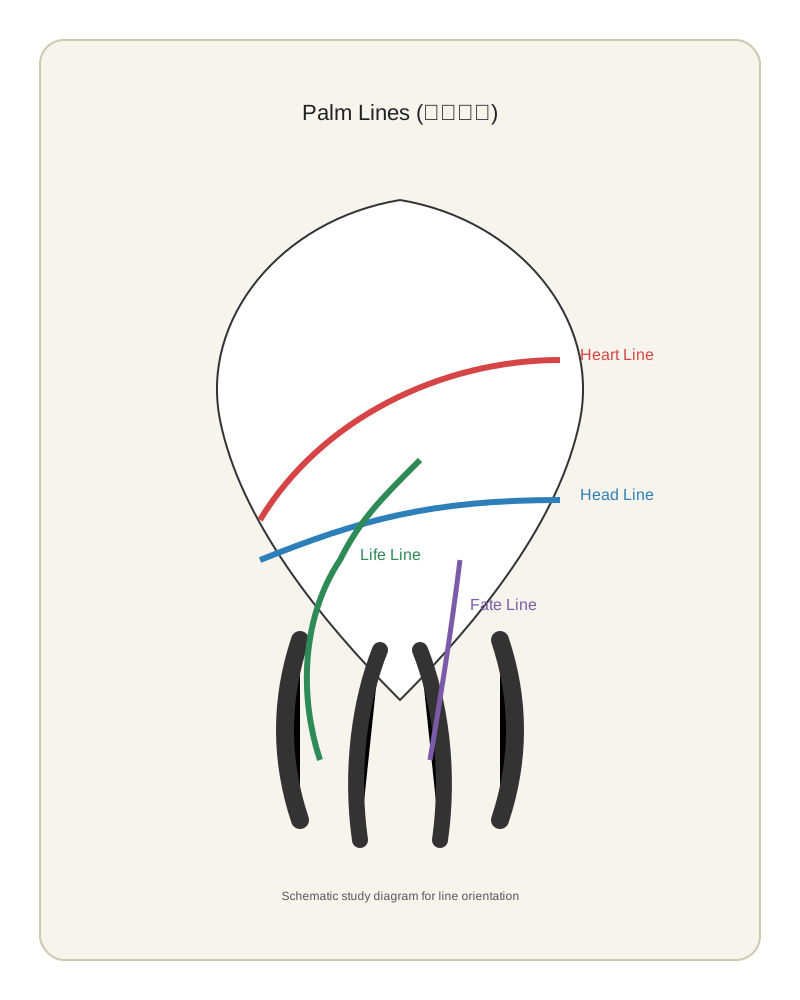
Reference: Primary line orientation (Heaven/Heart, Human/Head, Earth/Life, and Fate).
| Chinese Name | Western Name | Location | Domain | TCM Correlation |
|---|
天纹线
(Tiān Wén Xiàn) | Heart Line | Top of palm, horizontal beneath fingers | Emotions, love, spiritual connections — the highest domain (天 Heaven) | 心经 (Heart Meridian), 心包经 (Pericardium Meridian) |
人纹线
(Rén Wén Xiàn) | Head Line | Middle of palm, from thumb side across | Intellect, willpower, decision-making — mediating realm (人 Human) | 脑 (Brain), nervous system |
地纹线
(Dì Wén Xiàn) | Life Line | Curves around base of thumb | Physical vitality, life force (生命力), constitution — the physical body (地 Earth) | Overall constitution and immune system |
2.1 天纹线 — Heart Line (Heaven Line)
A long Heaven Line extending from beneath the little finger to beneath the index finger indicates deep emotional capacity and idealistic romanticism. A deeply etched line signifies intense passions; a straight line suggests rational control in relationships. Breaks (断裂 duànliè) indicate emotional trauma — divorce, betrayal, or loss — with the location along the line corresponding to approximate timing. Islands (岛纹 dǎo wén) signal periods of emotional confusion, depression, or cardiac health issues. Chains (锁链纹 suǒliàn wén) indicate emotional instability throughout the chained section.
2.2 人纹线 — Head Line (Human Line)
A Head Line curving downward toward the Moon mound (月丘 Yuè Qiū) indicates a creative, imaginative mind — common in artists and writers. A straight Head Line suggests a logical, mathematical mind. If the Head Line begins separately from the Life Line , the person is independent-minded; a shared origin indicates family-dependent caution. A fork at the terminus is called the 作家叉 (zuòjiā chā / "writer's fork") — the ability to see multiple perspectives simultaneously.
2.3 地纹线 — Life Line (Earth Line)
⚠️ Critical Misconception (重要误区)
The most widespread misconception in palmistry — both Chinese and Western — is that a short Life Line means a short life . This is categorically false. Classical texts including 《神相全编》 explicitly state that the Life Line indicates the quality of vitality, not the quantity of years. A short but deep, clear Life Line may belong to a person who lives to 90, while a long but chained Life Line may indicate chronic illness.
A Life Line that sweeps wide into the palm indicates abundant physical energy. One that stays close to the thumb suggests lower vitality. A parallel support line (辅助线 fǔzhù xiàn / "inner life line" 内生命线) running alongside mitigates the impact of any break. Age mapping (年龄划分 niánlíng huàfēn) : the origin near the index finger represents birth; midway corresponds to approximately age 40; the terminus near the wrist corresponds to age 70–80+.
Module 6: Special Patterns & Marks (特殊纹路与标记 - Tèshū Wénlù yǔ Biāojì)
6.1 Auspicious Marks (吉纹)
| Pattern | Chinese | Description | Significance |
|---|
| Star | 星纹 (Xīng Wén) | Three or more short lines crossing at a single point | On Jupiter = extraordinary success. On Sun = fame and fortune. On Moon = powerful imagination. On Saturn = sudden catastrophe (exception). |
| Triangle | 三角纹 (Sānjiǎo Wén) | Triangle formed by intersecting lines | Generally auspicious — intellectual achievement and mental acuity. On Head Line = scientific ability. |
| Square | 方格纹 (Fānggé Wén) | Square or rectangle on/near a line | Protective sign (保护纹 bǎohù wén) — mitigates breaks or islands, indicating crisis will be survived. |
6.2 Inauspicious Marks (凶纹)
| Pattern | Chinese | Description | Significance |
|---|
| Island | 岛纹 (Dǎo Wén) | Oval enclosed formation on any line | Universally a blockage: Heart Line = emotional/cardiac issues. Head Line = mental confusion. Life Line = illness. Fate Line = career obstruction. |
| Chain | 锁链纹 (Suǒliàn Wén) | Series of connected islands resembling a chain | Prolonged difficulty and weakness in that line's domain. Chained Heart Line = lifelong emotional instability. |
| Cross | 十字纹 (Shízì Wén) | Two short lines intersecting | Generally inauspicious on a major line (obstacles). But certain specific crosses are highly auspicious — see Mystic Cross. |
6.3 The Mystic Cross (神秘十字 Shénmì Shízì)
Found in the space between the Heart Line and Head Line, roughly center of palm. One of the most celebrated marks in both Chinese and Western palmistry. It indicates a person with strong intuitive, psychic, or spiritual abilities — 灵感 (línggǎn / spiritual sensitivity) and natural affinity for metaphysical studies and divination. Historically, many noted practitioners of the Five Arts (五术) are said to have possessed this mark. Condition: the cross must be independent, not formed by intersections of existing major lines.
6.4 The Ring of Solomon (所罗门环 / 智慧环 Zhìhuì Huán)
Also called 木星环 (Mùxīng Huán / Jupiter Ring) — a curved line encircling the base of the index finger across the Jupiter mound. Indicates exceptional wisdom, psychological insight, and the ability to understand and influence others. Common in counselors, psychologists, teachers, and spiritual leaders. In Chinese metaphysical practice, associated with 识人之明 (shí rén zhī míng / "the clarity to read people's character").
6.5 Fingerprint Patterns (指纹分析)
Chinese palmistry categorizes fingerprints into two primary types:
- 斗纹 (Dǒu Wén / Whorl — "bucket pattern"): Closed circular or spiral. Associated with 自主性 (independence), strong will, and fixed determination.
- 箕纹 (Jī Wén / Loop — "winnowing basket pattern"): Open loop. Associated with 适应性 (adaptability), flexibility, and cooperative sociability.
The folk rhyme "一斗穷,二斗富,三斗四斗卖豆腐" is a folk simplification not taken seriously in professional palmistry. In systematic analysis, the distribution of whorls and loops across all ten fingers reveals the balance between independence and adaptability in the personality.
Module 7: Case Studies (案例研究 - Ànlì Yánjiū)
Case 1: The Entrepreneur — 企业家的强命运线
Subject: Male, born 1965, Fujian Province. Right-handed.
Key Features: Deep, unbroken Fate Line (命运线) from wrist to Saturn mound. Exceptionally developed Jupiter mound (木星丘). Clear parallel Sun Line (太阳线). Long, straight Head Line. Wealth treasury triangle (财库三角) clearly visible.
Life Outcome: Founded a successful manufacturing company in the early 1990s during China's reform era. Expanded to international markets by 2005. The unbroken Fate Line from the wrist indicated early career clarity; the strong Jupiter mound confirmed natural leadership; the Sun Line indicated public recognition of success. The wealth triangle confirmed strong wealth retention ability.
Left vs Right: Left hand (先天手 / innate) showed a weaker Fate Line with a late start, suggesting innate destiny was not oriented toward early success. The strong right hand (后天手 / acquired) proved that his entrepreneurial success was built through deliberate effort — demonstrating 后天胜先天 (hòutiān shèng xiāntiān / "the acquired overcomes the innate").
Case 2: The Scholar — 学者的深长人纹线
Subject: Female, born 1978, Beijing. Left-handed.
Key Features: Extraordinarily long Head Line (人纹线) extending across the entire palm with gentle downward curve toward Moon mound. Well-developed Mercury mound (水星丘). 多纹掌 (duō wén zhǎng / "many-lined palm") indicating intellectual restlessness. Writer's fork (作家叉) at the Head Line terminus.
Life Outcome: Earned PhD in comparative literature, became university professor and published author. The long, curving Head Line indicated both analytical depth (length) and creative imagination (curve toward Moon). The writer's fork confirmed literary ability. Mercury development supported communication skills as teacher and writer.
Case 3: Health Prediction — 生命线岛纹与重病
Subject: Female, born 1958, Shanghai.
Key Features: Generally strong, deep Life Line (地纹线) with a distinct island (岛纹) at the age-point corresponding to approximately 45 years. Health Line (健康线) crossed the Life Line near the same point.
Life Outcome: At age 46 (2004), diagnosed with breast cancer. Underwent surgery and chemotherapy. The island on the Life Line precisely corresponded to this period of illness. After the island, the Life Line continued strongly, and a protective square (方格纹) partially enclosed the island — the classical "protection mark" indicating survival of the crisis. She recovered fully and was in good health at her reading in 2010.
Diagnostic Accuracy: Island position matched illness timing. Protective square predicted recovery. Continued strong Life Line confirmed post-crisis vitality. ✓
Case 4: Short Life Line Misconception — 短生命线的长寿者
Subject: Female, born 1925, Zhejiang Province. Palm read in 2012 (age 87) and 2015 (age 90).
Key Features: Life Line (地纹线) terminated abruptly at approximately age 50 on standard age-mapping. However, a strong inner Life Line (内生命线 / Mars line 火星线) ran parallel on the inner side, continuing well past the main line's terminus. Venus mound (金星丘) was exceptionally full and firm even at advanced age.
Life Outcome: Subject lived to 93 years old. Textbook demonstration that a short Life Line does not mean a short life . The inner Life Line "extended" vitality. Her Life Line did show a significant shift around age 50 — she relocated from rural Zhejiang to urban Shanghai, representing a major lifestyle transformation rather than death.
Case 5: Palm Color & TCM Diagnosis — 掌色诊断
Subject: Male, born 1968, Wuhan. Reading performed in 2015.
Key Features: Overall palm color noticeably reddish (红色) in the thenar eminence (大鱼际 / Venus mound area). Palm slightly damp and warm. Lunulae (月牙) absent on 6 of 10 fingernails. Horizontal ridges (横纹) on several nails.
TCM Analysis: Reddish thenar eminence with dampness = classical indicator of 肝火旺盛 (gān huǒ wàngshèng / "liver fire excess"). Absent lunulae = 阳气不足 (yáng qì bùzú / "Yang Qi deficiency") and weakened metabolism. Horizontal ridges = past severe stress periods.
Life Outcome: Medical examination confirmed elevated liver enzymes and early-stage fatty liver disease (脂肪肝). Chronic fatigue and digestive issues confirmed Yang Qi deficiency. This case illustrates the diagnostic overlap between Chinese palmistry and TCM. ✓
Case 6: Multiple Marriages — 多婚姻线 (Duō Hūnyīn Xiàn)
Subject: Male, born 1960, Guangdong Province.
Key Features: Three clear, distinct Marriage Lines (婚姻线) on the percussion edge beneath the little finger. The lowest line was short and faint; the middle line was the deepest and longest; the topmost line was of medium depth with a fork at its end. The Heart Line (天纹线) was chained in its early section (beneath Mercury and Sun) but became clear in the Jupiter region.
Life Outcome: First marriage at age 22 (lowest line — short, ended in divorce within 2 years). Second marriage at age 30 (middle line — deepest, lasting 15 years and producing two children). Third marriage at age 50 (topmost line — forked end indicated eventual separation). The chained Heart Line in its early section correlated with emotional instability in youth, while the clearer section later indicated growing emotional maturity.
Palmistry Principle: Marriage Lines are read by depth, length, and quality of their markings — not merely by count. The deepest line always represents the most significant relationship regardless of chronological order.
Case 7: The Self-Made Millionaire — 白手起家百万富翁
Subject: Male, born 1972, Wenzhou (温州 — a city famous for its entrepreneurial culture).
Key Features: A prominent wealth treasury triangle (财库三角) formed by the intersection of the Fate Line, Head Line, and a secondary diagonal line. Multiple clear Wealth Lines (财运线) beneath the ring and little fingers. The Head Line (人纹线) was straight and long — practical and calculating. Jupiter mound (木星丘) and Mercury mound (水星丘) were both well-developed. The Fate Line began from the Moon mound (月丘), indicating success through public interaction and external contacts.
Life Outcome: Started with no family wealth; built a chain of restaurants across China's eastern seaboard by his mid-thirties. The Fate Line from the Moon mound precisely indicated success through public-facing business rather than inherited resources. The wealth triangle confirmed strong ability to both generate and retain wealth.
Case 8: Children Lines Accuracy — 子女线的精确预测
Subject: Female, born 1970, Chengdu. Reading performed in 2008.
Key Features: Three fine vertical lines crossing the primary Marriage Line. Two lines were deeper and stronger; one was finer and more delicate. The deeper lines were interpreted as sons, the fine line as a daughter, following traditional Chinese convention.
Life Outcome: The subject had exactly three children: two sons (born 1993 and 1996) and one daughter (born 2001). The relative positions of the Children Lines corresponded to birth order — the two deeper lines closer to the percussion edge (earlier births), the fine line closer to the palm center (later birth). The palmist's reading was confirmed as retrospectively accurate. ✓
Case 9: Travel and Emigration — 旅行线与移民
Subject: Male, born 1980, Fuzhou, Fujian Province.
Key Features: Multiple prominent Travel Lines (旅行线) on the lower percussion edge, emanating from the Life Line area and extending strongly toward the Moon mound (月丘). One travel line was significantly deeper and longer than the others, extending well into the Moon mound. The Moon mound itself was well-developed.
Life Outcome: Emigrated to Australia at age 25, established permanent residency, and built a career in international trade. The dominant travel line indicated a major, permanent relocation rather than mere tourism. Smaller travel lines corresponded to significant business trips to Southeast Asia and Europe.
Principle: A travel line that penetrates deeply into the Moon mound signals permanent emigration; one that merely touches the mound's edge signals temporary travel.
Case 10: Artistic Talent — 太阳线与艺术天赋
Subject: Female, born 1985, Hangzhou.
Key Features: A strong, clear Sun Line (太阳线) running from the upper palm to the ring finger base. The Head Line (人纹线) curved dramatically downward into the Moon mound, indicating powerful creative imagination. The Sun mound (太阳丘) was exceptionally well-developed. Multiple fine lines radiated upward from the Head Line toward the Sun mound. Pointed fingertips on most fingers — the "artistic" finger shape (尖形指).
Life Outcome: Became a successful painter and installation artist, exhibiting in galleries across China and internationally. The dramatic Head Line curve into the Moon mound is one of the strongest indicators of creative/artistic imagination. The Sun Line confirmed that her talent would achieve public recognition. The pointed fingertips aligned with the idealistic, aesthetically sensitive personality type.
Case 11: Left Hand vs Right Hand — 左右手差异的人生转变
Subject: Male, born 1975, Xi'an. Right-handed.
Left hand (先天手 / innate potential): Short Fate Line beginning only at the Head Line (mid-palm) — late start in career. Heart Line was chained — emotional instability in the innate character. Life Line was short with no inner support line.
Right hand (后天手 / developed reality): Strong Fate Line beginning from the wrist — career direction established early through personal effort. Heart Line was clear and deep — emotional stability achieved through maturity. Life Line was strong with a supporting inner line.
Analysis: The dramatic difference between the two hands revealed a person who transformed himself significantly from his innate tendencies. This case demonstrates 后天胜先天 (hòutiān shèng xiāntiān) — "the acquired overcomes the innate" — a fundamentally empowering principle that distinguishes Chinese palmistry from fatalistic approaches.
Case 12: Fingerprint Analysis — 箕纹与斗纹的人格对应
Subject: Female, born 1982, Nanjing.
Fingerprint Pattern: 7 whorls (斗纹) and 3 loops (箕纹): whorls on both thumbs, both index fingers, left middle, right ring, and left little finger; loops on right middle, left ring, and right little finger.
Traditional Interpretation: 7 whorls indicates a highly independent, self-reliant personality with strong willpower but potential difficulty in compromise. Whorl dominance on thumbs (willpower) and index fingers (Jupiter/leadership) particularly emphasized independence and ambition. The three loops on middle, ring, and little fingers provided just enough adaptability and social skill to maintain relationships.
Life Outcome: Became a successful independent consultant — working for herself rather than within corporate structures — confirming the independence drive. The folk rhyme "一斗穷,二斗富,三斗四斗卖豆腐" is a simplified mnemonic; professional analysis uses the full 10-finger distribution pattern for nuanced assessment. ✓
Module 8: Chinese vs Western Palmistry (中西手相比较 - Zhōng Xī Shǒu Xiàng Bǐjiào)
| Dimension (维度) | Chinese Palmistry (中国手相) | Western Palmistry |
|---|
| Cosmological Framework | Integrated with 五行 (Wǔ Xíng), 阴阳, 天地人 triad | Rooted in Greco-Roman astrology and Hermetic tradition |
| Line Naming | Heaven (天), Human (人), Earth (地) — cosmological | Heart, Head, Life — named by function |
| Health Diagnosis | Deep integration with TCM meridian theory, Qi flow, constitutional typing | Primarily symbolic; less emphasis on medical diagnosis |
| Hand Dominance | 先天手 (innate) vs 后天手 (acquired) — transformation is emphasized | Non-dominant = potential, dominant = developed self |
| Palm Color/Texture | Extensive TCM-based diagnostic system (color, temperature, moisture) | Generally not emphasized to the same degree |
| Elemental System | 五行 (Five Elements) mapped to mounds and fingers with interaction rules | Four classical elements (Earth, Air, Fire, Water) mapped to hand shapes |
| Practice Integration | Practiced alongside 面相, BaZi, Feng Shui as part of 五术 | Often practiced as a standalone discipline |
| Nail Diagnosis | Extensive (lunulae, color, ridges, shape) — overlapping with TCM | Basic; less medical emphasis |
| Fate Philosophy | 变化 (biànhuà) — lines change; 后天胜先天; destiny can be modified | More deterministic in popular forms; lines show fixed fate |
8.1 Philosophical Differences — 变化 vs Determinism
The most fundamental difference is philosophical. Western palmistry, especially in popular form, tends toward deterministic fatalism — the lines reveal a fixed future. Chinese palmistry, rooted in Daoist and Confucian philosophy, emphasizes 变化 (biànhuà / change) . The lines of the palm change over time — a principle consistent with the 易经 (Yì Jīng) cosmology that everything is in constant transformation.
The Chinese concept of 后天胜先天 (hòutiān shèng xiāntiān / "the acquired overcomes the innate") means that while the non-dominant hand reveals innate potential and karmic inheritance, the dominant hand shows what the person has made of that potential through effort, cultivation, and choice. This opens the door to 改运 (gǎi yùn / "changing one's luck") — the idea that conscious action can modify destiny.
8.2 The Five Elements Integration — 五行互动框架
Chinese palmistry's most distinctive feature is its integration of 五行 (Wǔ Xíng / Five Elements) theory. Each finger, mound, and palm region is assigned an elemental correspondence, and the interactions between these elements (生克关系 / shēng kè guānxì / "generating and controlling relationships") are analyzed:
- 木生火 (Mù shēng Huǒ / Wood generates Fire): Jupiter finger feeds Sun finger — ambition fuels creativity.
- 火生土 (Huǒ shēng Tǔ / Fire generates Earth): Sun energy feeds Saturn — fame leads to stability.
- 金克木 (Jīn kè Mù / Metal controls Wood): Venus may restrain Jupiter — love/pleasure may dampen ambition.
- 水克火 (Shuǐ kè Huǒ / Water controls Fire): Mercury or Moon may restrain Sun — over-analysis or excessive imagination can dampen creative output.
This Five Elements analysis has no parallel in Western palmistry. In the Chinese system, the palm is not merely a collection of independent lines and mounds — it is a dynamic ecosystem of interacting elemental forces, mirroring the macrocosmic interactions of the universe within the microcosm of the human hand.
8.3 Key Terminology Quick Reference (术语速查 Shùyǔ Sù Chá)
| Chinese (中文) | Pinyin | English |
|---|
| 手相 | shǒu xiàng | Palmistry / hand physiognomy |
| 天纹线 | tiān wén xiàn | Heaven Line (Heart Line) |
| 人纹线 | rén wén xiàn | Human Line (Head Line) |
| 地纹线 | dì wén xiàn | Earth Line (Life Line) |
| 命运线 | mìngyùn xiàn | Fate Line |
| 太阳线 | tàiyáng xiàn | Sun Line |
| 婚姻线 | hūnyīn xiàn | Marriage Line |
| 子女线 | zǐnǚ xiàn | Children Line |
| 财运线 | cáiyùn xiàn | Wealth Line |
| 旅行线 | lǚxíng xiàn | Travel Line |
| 掌丘 | zhǎng qiū | Palm mound/mount |
| 岛纹 | dǎo wén | Island pattern (blockage) |
| 锁链纹 | suǒliàn wén | Chain pattern (instability) |
| 神秘十字 | shénmì shízì | Mystic Cross (spiritual sensitivity) |
| 财库三角 | cáikù sānjiǎo | Wealth treasury triangle |
| 先天手 | xiāntiān shǒu | Innate hand (non-dominant) |
| 后天手 | hòutiān shǒu | Acquired hand (dominant) |
| 斗纹 | dǒu wén | Whorl fingerprint (independence) |
| 箕纹 | jī wén | Loop fingerprint (adaptability) |
| 后天胜先天 | hòutiān shèng xiāntiān | "The acquired overcomes the innate" |
🛠️ Connection to Liuren Fajiao
Shou Xiang (手相) and Mian Xiang (面相) together form the core of the Xiang (相) branch of the Five Arts. For the Liuren practitioner, palmistry provides an immediate, non-invasive diagnostic tool that complements destiny analysis (命 BaZi), divination (卜 Liu Yao / Da Liu Ren), and ritual practice.
Practical Integration Points
- 手面合参 (Jointly Consulting Hand and Face): Classical Chinese physiognomists never read the palm in isolation. A Liuren practitioner combines Mian Xiang face reading with Shou Xiang palm reading for comprehensive character and health assessment — two windows into the same person's Qi.
- Client Assessment Before Ritual (望诊): When a client approaches a Liuren master with a complex problem, a quick palm reading can identify constitutional strengths and weaknesses — liver fire, Yang Qi deficiency, emotional instability — guiding which ritual protocol to employ and which herbal or talismanic support to recommend.
- BaZi Cross-Verification (命相互参): A person's BaZi chart may show strong Water element, and their palm should confirm this — well-developed Mercury and Moon mounds, deep Head Line curving toward Moon. When BaZi and palmistry agree, diagnostic confidence increases significantly. When they disagree, it signals the 后天 (acquired) effort has modified the 先天 (innate) pattern.
- Health Monitoring (TCM Integration): Nail analysis (月牙, ridges, color) and palm color/texture provide real-time health indicators that complement the constitutional picture revealed by BaZi. This is especially valuable for monitoring changes over time between consultations.
- The Mystic Cross and Practitioner Selection: The presence of the 神秘十字 (Mystic Cross) between the Heart and Head Lines has traditionally been considered a marker of individuals with natural affinity for metaphysical practice. Masters in the Liuren lineage have historically noted this mark in talented apprentices.
In the Liuren tradition, the Xiang arts represent the most accessible entry point for students — requiring no calculations, no calendar lookup, no casting of coins. The practitioner learns to see the Qi directly as it manifests in the body, developing the observational sensitivity that later deepens work in all other branches of the Five Arts.